/Events /AgentCon - Toronto
AgentCon - Toronto
This event is part of AgentCon, organized by Global AI Toronto.
Schedule
About
Join us for the AI Agents World Tour, a global series of one-day conferences designed exclusively for developers building the future with AI agents.
From San Francisco to Singapore, we’re bringing together leading engineers, researchers, and creators to explore the cutting edge of AI agent design, deployment, and integration. Whether you’re building intelligent assistants, autonomous systems, or next-gen developer tools, this event is your fast track to practical knowledge, hands-on demos, and real-world insights.
What to Expect:
- Deep-Dive Talks from AI pioneers and industry leaders
- Technical Workshops on building, deploying, and scaling agents
- Live Demos of powerful open-source frameworks and tools
- Networking with a global community of builders and innovators
This isn't just another AI event — it’s where developers meet to talk about real code.
Ready to build the future?
Who's on stage
Tony He is an AI Engineer at DotsLive and Researcher at Ivey. He specializes in architecting communication frameworks for interacting agents and integrating autonomous intelligence into Talent CRM platforms.
Masters in AI, worked developing AI agents for companies

Dev J. Shah is a Full Stack Developer and AI Evangelist based in Toronto, Canada. With nearly two years of professional experience, he specializes in building scalable web applications and integrating AI technologies into development workflows. Dev actively contributes to the tech community through insightful blog posts on Dev.to and instructional videos on YouTube, focusing on simplifying complex AI concepts and tools. He holds an Advanced Diploma in Computer Programming and Analysis from Seneca Polytechnic, graduating with honors, and a Diploma in Electrical Engineering from The Maharaja Sayajirao University of Baroda.

Rajaganesh Vijayaraj is an Associate Partner at IBM Consulting focused on agentic AI on Azure AI, helping enterprises move from pilots to production with secure, governable AI agents. He brings two decades of experience in cloud, architecture, and large-scale delivery across IBM, CGI and TCS. LinkedIn Profile https://www.linkedin.com/in/rajaganesh-vijayaraj-15848412/

matt-douglas@hotmail.com

Marino Wijay is a Canadian, Traveller, International Speaker, and Open Source Advocate and Architect for AI, API Platforms, Service Mesh, Kubernetes, and Networking. He is a CNCF Ambassador, Civo Cloud Ambassador, Lead Organizer for KubeHuddle Toronto, and Founder of EmpathyOps. He is passionate about technology and modern distributed systems. He will always fall back to the patterns of Networking and the ways of the OSI. Community building is his driving force; A modern Jedi Academy.

Henk is a Cloud Advocate specializing in Artificial intelligence and Azure with a background in application development. He is currently part of the AI cloud advocate team and based in the Netherlands. Before joining Microsoft, he was a Microsoft AI MVP and worked as a software developer and architect building lots of AI powered platforms on Azure.

Hugo Guerrero specializes in building the backbone of the AI era. As a technology leader, he focuses on AI-ready infrastructure, modern API strategy, and scalable event-driven systems. A frequent speaker and advocate for developer ecosystems, Hugo is passionate about turning complex architectural concepts into real-world results. He works at the intersection of connectivity and intelligence, ensuring that today’s infrastructure is ready for tomorrow’s agentic workflows.

As a Subject Matter Expert, I operate at the intersection of agentic systems, large-scale data platforms, and real-time infrastructure, leading research and architecture for systems where data, equipment, and applications become active, self-governing entities. My work focuses on defining and evolving agent-native system architectures that span cloud, on-prem, and hybrid environments. I design platforms where datasets, filesystems, equipment catalogs, and services own their workflows, lifecycle, and operational intent, enabling near real-time adaptation, autonomous coordination, and policy-driven execution. I stay hands-on with the systems I design. I prototype, wire up, stress-test, and iterate on real platforms - often moving from whiteboard to running code, from UI interaction to control plane logic, from local experiments to production-grade infrastructure. I work across frontend, backend, and infrastructure layers, not as isolated components but as a single system that must behave predictably under load, failure, and change. My focus is on making complex systems understandable, operable, and pleasant to evolve - for both humans and machines. I build systems around reliability, security, and isolation by design, using declarative resource models, infrastructure-as-code, and custom controllers to map desired state into observable, governable reality. I actively integrate practices from AIOps, MLOps, DevSecOps, and Site Reliability Engineering, ensuring that intelligent systems remain explainable, operable, and safe at scale. A core strength of my work is designing near real-time telemetry, metrics, and event pipelines that operate across heterogeneous environments and process data at multi-terabyte scale. These pipelines are not treated as observability add-ons, but as first-class architectural primitives that enable feedback, learning, and adaptation. My experience spans high-reliability and regulated domains, including finance, pharmaceutical manufacturing, and industrial automation. This includes architecting reactive financial systems, contributing to GxP-aligned MES platforms, and designing control and automation systems for semiconductor manufacturing and robotics, with deep experience in SECS/HSMS-based integrations.

Viktor Gamov is a Principal Developer Advocate at Confluent, founded by the original creators of Apache Kafka®. With a rich background in implementing and advocating for distributed systems and cloud-native architectures, Viktor excels in open-source technologies. He is passionate about assisting architects, developers, and operators in crafting systems that are not only low in latency and scalable but also highly available. As a Java Champion and an esteemed speaker, Viktor is known for his insightful presentations at top industry events like JavaOne, Devoxx, Kafka Summit, and QCon. His expertise spans distributed systems, real-time data streaming, JVM, and DevOps. Viktor has co-authored "Enterprise Web Development" from O'Reilly and "Apache Kafka® in Action" from Manning. Follow Viktor on X—@gamussa to stay updated with his latest thoughts on technology, his gym and food adventures, and insights into open-source and developer advocacy.

Seasoned software engineer specialized in AI agents and NLP currently working on applied AI agent for future of work research projects with faculties at the Ivey Business School.
Syed Shariyar Murtaza is an AI leader and innovator specializing in applied machine learning for life insurance, enterprise workflows, and intelligent systems. As an AVP of AI at Manulife Financial, he focuses on building real-world agentic AI solutions that transform business operations and decision-making. His work spans converting complex domain knowledge into executable workflows, designing advanced LLM-based underwriting systems, and creating benchmark datasets for evaluating AI in regulated environments. Shariyar holds a Ph.D. in Computer Science from the University of Western Ontario and is also an adjunct faculty member at Toronto Metropolitan University, where he teaches natural language processing and data science.

Guy works for Redis as a Developer Advocate. Combining his decades of experience in writing software with a passion for learning—and for sharing what he has learned—Guy explores interesting topics and spreads the knowledge he has gained around developer communities worldwide. Teaching and community have long been a focus for Guy. He ran a local JavaScript meetup in Ohio for more than a decade and has served on the selection committees of numerous conferences. He'll happily speak anywhere that will have him and has even has helped teach programming at a prison in Central Ohio. In his personal life, Guy is a hard-boiled geek interested in role-playing games, science fiction, and technology. He also has a slightly less geeky interest in history and linguistics. He has an entire wall of role-playing games and science fiction books, speaks Spanish like a two-year old, and is a ham radio operator—callsign W8GUY. Guy lives in Ohio with his wife. His three sons are adults now and are all moved out. He is immensely proud of the men they have become.

With over 40 years as a coder, Ryan Hamilton is a senior software engineer on the AI Team at CircleCI, where he participates heavily in research and development efforts to understand how AI is actually transforming software delivery — beyond the hype. Spending most afternoons after school at his father's software store in the early 80's, he started writing code in second grade on an Apple II in BASIC, and has been coding in countless capacities ever since. Now he codes (mostly in English) on M4 MacBook Pros, while conducting extensive interviews with engineering teams navigating the AI revolution. For him, "software delivery" has meant everything from shipping floppy disks in cardboard boxes to watching teams YOLO AI-generated apps into production on vibes — and then (at best) measuring what actually happens. He believes certain timeless SDLC principles remain intact through it all, and that honest conversations about what's working (and what isn't) matter more than another hype cycle.

Rey serves as Senior Developer Advocate for Solace. Since 2016 Rey has been advocating for developers, doing what he can to make developers lives easier and more fun, driving awareness and creating code to make developers successful. Being well-versed in a plethora of languages over the last decade has given Rey a vast look at the developer community as a whole. Committed to helping developers of all sorts Rey is also a co-organizer for the ForwardJS Javascript Meetup group, a co-organizer for Random Hacks of Kindness and an organizer for developer focused conferences, including ForwardJS Ottawa.
Sessions & tracks
Registration
Main room ·Opening / Welcome to AgentCon
Main room ·Agents of Tomorrow: Building the Next Generation of Intelligence
We stand at the edge of a profound shift in artificial intelligence. Over the last five years, generative AI has moved from novelty to necessity—transforming how we create, code, and collaborate. Now, a new frontier is emerging: AI agents. Unlike traditional tools that wait for instructions, agents can perceive, decide, and act toward goals—expanding the boundaries of what humans and machines can achieve together.
In this keynote, we’ll explore the evolution from copilots to fully agentic systems, highlight breakthroughs that are reshaping industries, and imagine the future horizons where autonomous agents redefine productivity, creativity, and discovery. Most importantly, we’ll discuss the role of humans in this new era—not as bystanders, but as leaders guiding how agents operate, align with our values, and amplify our potential.
The Agents of Tomorrow are here—and the future will be built by those bold enough to partner with them.
Henk is a Cloud Advocate specializing in Artificial intelligence and Azure with a background in application development. He is currently part of the AI cloud advocate team and based in the Netherlands. Before joining Microsoft, he was a Microsoft AI MVP and worked as a software developer and architect building lots of AI powered platforms on Azure.
Break
Main room ·Implementing Retrieval Augmented Generation Technique on Unstructured and Structured Data Sources
The retrieval-augmented generation (RAG) technique enables generative AI models to extract accurate facts from external unstructureddata sources. For structured data, RAG is further augmented by function calls to query databases. This paper presents an industrialcase study that implements RAG in a large financial institution’s call center. The study showcases experiences and architecture for ascalable RAG deployment. It also introduces enhancements to RAG for retrieving facts from structured data sources using data embeddings, achieving low latency and high reliability. Our optimized production application demonstratesan average response time of only 7.33 seconds. Additionally, the paper compares various open-source and closed-source models for answer generation in an industrial context.
Syed Shariyar Murtaza is an AI leader and innovator specializing in applied machine learning for life insurance, enterprise workflows, and intelligent systems. As an AVP of AI at Manulife Financial, he focuses on building real-world agentic AI solutions that transform business operations and decision-making. His work spans converting complex domain knowledge into executable workflows, designing advanced LLM-based underwriting systems, and creating benchmark datasets for evaluating AI in regulated environments. Shariyar holds a Ph.D. in Computer Science from the University of Western Ontario and is also an adjunct faculty member at Toronto Metropolitan University, where he teaches natural language processing and data science.
Event-Driven AI: Build Autonomous Agents That Think Asynchronously
The shift from "chatbots" to autonomous AI agents is reshaping how applications interact with users and systems. Triggering an agent via a standard synchronous API call often leads to timeouts, ghosting, and poor user experiences. Unlike simple responses, AI agents need to think, plan, and execute across multiple steps, which requires an architecture built for asynchronous operation. In this session, we introduce the concept of the Event-Driven Agent. By treating AI as an asynchronous participant in your system, you can build complex, multi-step workflows that are resilient, scalable, and observant. We’ll explore real-world examples of implementing event-driven agentic systems, from simple observer patterns to full-scale orchestration of AI agents alongside microservices.
Hugo Guerrero specializes in building the backbone of the AI era. As a technology leader, he focuses on AI-ready infrastructure, modern API strategy, and scalable event-driven systems. A frequent speaker and advocate for developer ecosystems, Hugo is passionate about turning complex architectural concepts into real-world results. He works at the intersection of connectivity and intelligence, ensuring that today’s infrastructure is ready for tomorrow’s agentic workflows.
Marino Wijay is a Canadian, Traveller, International Speaker, and Open Source Advocate and Architect for AI, API Platforms, Service Mesh, Kubernetes, and Networking. He is a CNCF Ambassador, Civo Cloud Ambassador, Lead Organizer for KubeHuddle Toronto, and Founder of EmpathyOps. He is passionate about technology and modern distributed systems. He will always fall back to the patterns of Networking and the ways of the OSI. Community building is his driving force; A modern Jedi Academy.
Simulated Worlds for Agent Engineering: Planning, Policy, and Evaluation
As AI agents move beyond single-prompt demos into multi-step, autonomous workflows, teams face a core challenge: how do we design, test, and govern agent behavior before deploying it into real systems?
This talk presents simulated worlds as a practical engineering tool for building and evaluating agent systems. Using a controlled, Doom-like simulation environment, we explore how agents can plan actions, coordinate with other agents, operate under explicit policy constraints, and be evaluated over long-running interactions.
Rather than focusing on game mechanics, the simulation is used as a safe, repeatable laboratory for agent engineering. We’ll examine how structured environments help surface failure modes early, make agent behavior observable, and enable meaningful evaluation beyond simple task success.
Topics include:
- Designing agent planning and decision loops in constrained environments
- Enforcing policy and safety boundaries at runtime
- Multi-agent coordination and conflict handling
- Behavioral and lifecycle-based evaluation metrics for agents
- Lessons learned translating simulation insights to real workflows
This session is framework-agnostic and aimed at developers and architects who want reliable, testable, and governable agent systems, not just clever prompts.
As a Subject Matter Expert, I operate at the intersection of agentic systems, large-scale data platforms, and real-time infrastructure, leading research and architecture for systems where data, equipment, and applications become active, self-governing entities. My work focuses on defining and evolving agent-native system architectures that span cloud, on-prem, and hybrid environments. I design platforms where datasets, filesystems, equipment catalogs, and services own their workflows, lifecycle, and operational intent, enabling near real-time adaptation, autonomous coordination, and policy-driven execution. I stay hands-on with the systems I design. I prototype, wire up, stress-test, and iterate on real platforms - often moving from whiteboard to running code, from UI interaction to control plane logic, from local experiments to production-grade infrastructure. I work across frontend, backend, and infrastructure layers, not as isolated components but as a single system that must behave predictably under load, failure, and change. My focus is on making complex systems understandable, operable, and pleasant to evolve - for both humans and machines. I build systems around reliability, security, and isolation by design, using declarative resource models, infrastructure-as-code, and custom controllers to map desired state into observable, governable reality. I actively integrate practices from AIOps, MLOps, DevSecOps, and Site Reliability Engineering, ensuring that intelligent systems remain explainable, operable, and safe at scale. A core strength of my work is designing near real-time telemetry, metrics, and event pipelines that operate across heterogeneous environments and process data at multi-terabyte scale. These pipelines are not treated as observability add-ons, but as first-class architectural primitives that enable feedback, learning, and adaptation. My experience spans high-reliability and regulated domains, including finance, pharmaceutical manufacturing, and industrial automation. This includes architecting reactive financial systems, contributing to GxP-aligned MES platforms, and designing control and automation systems for semiconductor manufacturing and robotics, with deep experience in SECS/HSMS-based integrations.
Self‑Auditing Agents: Agents That Explain and Critique Their Own Actions
During this session, i will cover how to pair every “worker” agent with a lightweight “auditor” agent that inspects tool calls, intermediate reasoning, and outputs, generating human‑friendly “decision narratives” and flagging policy/compliance risks before actions execute.This session will help us educate the audience on multi‑agent orchestration, evaluation, and responsible AI in a very concrete pattern developers can reuse across frameworks
Rajaganesh Vijayaraj is an Associate Partner at IBM Consulting focused on agentic AI on Azure AI, helping enterprises move from pilots to production with secure, governable AI agents. He brings two decades of experience in cloud, architecture, and large-scale delivery across IBM, CGI and TCS. LinkedIn Profile https://www.linkedin.com/in/rajaganesh-vijayaraj-15848412/
Lunch
Main room ·The Missing Protocol: How MCP Bridges LLMs and Data Streams
Nobody's talking about this: MCP isn't just another way to build chatbots. It's the bridge we've been missing between AI reasoning and real-time data systems. Teams build AI applications that work great in demos but fall apart with production data. Your agents analyze historical reports but can't tell what's happening in your Kafka streams. They're blind to schema changes and disconnected from events that matter to your business. Instead of treating streaming platforms like black boxes, you expose them directly to your agents via MCP protocol. Suddenly, your AI doesn't just read about data—it lives inside your data flows. Learn what becomes possible when you stop thinking about AI as an external service and start treating it as part of your streaming architecture. We'll build systems where agents subscribe to real-time events, reason about evolving schemas, and make decisions that ripple through your data platform.
Viktor Gamov is a Principal Developer Advocate at Confluent, founded by the original creators of Apache Kafka®. With a rich background in implementing and advocating for distributed systems and cloud-native architectures, Viktor excels in open-source technologies. He is passionate about assisting architects, developers, and operators in crafting systems that are not only low in latency and scalable but also highly available. As a Java Champion and an esteemed speaker, Viktor is known for his insightful presentations at top industry events like JavaOne, Devoxx, Kafka Summit, and QCon. His expertise spans distributed systems, real-time data streaming, JVM, and DevOps. Viktor has co-authored "Enterprise Web Development" from O'Reilly and "Apache Kafka® in Action" from Manning. Follow Viktor on X—@gamussa to stay updated with his latest thoughts on technology, his gym and food adventures, and insights into open-source and developer advocacy.
Agents & Arbiters - An Adventurer’s Guide to Multi-Agent Collaboration with LangGraph.js
Building interactive systems with conventional coding means trying to anticipate every possible user action and writing the right response. This quickly becomes nigh impossible. You end up lost in a maze of recursion, fragility, and nested if statements. The more interactive you make your system, the more complex your code gets, until debugging feels like being eaten by a grue—you know something's wrong, but you're just fumbling around in the dark.
There's a better way. Instead of scripting every interaction, we can give some of the elements in our system their own intelligence. Multi-agent collaboration lets us create systems where entities can become autonomous agents with their own perspectives and voices. Imagine a text-based adventure game where the brass lantern, the white house, and even the mailbox have something to say when responding to the player. Or consider a help desk system where agents from billing, technical support, and account management each weigh in to determine the best solution for a customer.
In this session, we'll explore multi-agent collaboration through a live demo of a text-based adventure system. You'll meet the orchestration workflow—router, classifier, agents, arbiter, and committer—and discover how LangGraph.js coordinates the chaos when multiple agents want to respond. We'll shine our brass lantern over the code to see how it uses Redis and LangGraph.js to make it all work. Then, we'll explore how this same approach solves real-world problems beyond gaming.
When the adventure's over, you'll understand how to coordinate agents to handle complex interactions and know when this is a good approach. You'll have a working example you can adapt for your own adventures—be they exploring the Great Underground Empire, customer service platforms, or content management systems. And, you'll never look at building interactive systems the same way again.
Guy works for Redis as a Developer Advocate. Combining his decades of experience in writing software with a passion for learning—and for sharing what he has learned—Guy explores interesting topics and spreads the knowledge he has gained around developer communities worldwide. Teaching and community have long been a focus for Guy. He ran a local JavaScript meetup in Ohio for more than a decade and has served on the selection committees of numerous conferences. He'll happily speak anywhere that will have him and has even has helped teach programming at a prison in Central Ohio. In his personal life, Guy is a hard-boiled geek interested in role-playing games, science fiction, and technology. He also has a slightly less geeky interest in history and linguistics. He has an entire wall of role-playing games and science fiction books, speaks Spanish like a two-year old, and is a ham radio operator—callsign W8GUY. Guy lives in Ohio with his wife. His three sons are adults now and are all moved out. He is immensely proud of the men they have become.
Autopoietic Neuro-Symbolic Architectures in Resource-Constrained Environments
JARVIS (Just A Rather Very Intelligent System) OMNI V2 is an advanced AI assistant framework that can autonomously create, refactor, and improve its own skills. Built with a sophisticated multi-LLM architecture and self-healing capabilities, JARVIS learns and adapts to provide intelligent automation for daily tasks, financial analysis, home automation, and much more.
🧠 Core Capabilities
- Self-Evolution: Autonomously generates new skills using The Triumvirate (multi-agent consensus system)
- Self-Healing: Automatically detects and fixes broken skills
- Self-Knowledge Management: Automatically indexes own documentation for autonomous introspection
- Deep Research: DeepSearcher-powered vector search with multi-iteration RAG for knowledge retrieval
- Multi-LLM Routing: Intelligently routes tasks to optimal language models (Google Gemini, Ollama)
- Native Tool Calling: Native Gemini function calling for improved response accuracy and reliability
- Adaptive Learning: Reinforcement learning with Q-networks for skill selection optimization
- Semantic Skill Selection: Embedding-based skill matching with cached embeddings for fast selection
- Conversation Memory: Long-term SQLite-based memory with recency weighting and context retrieval
- Deep Memory: Neo4j-based Knowledge Graph for long-term relational knowledge (The Hippocampus)
- Session Layer: Short-term transient state management for context retention (focus, active skill)
- Real-time Event Processing: Event bus architecture for reactive behaviors
- Voice Integration: Full voice input/output capabilities with wake word detection and TTS
⚡ Performance Optimizations
- LLM Response Caching: Semantic similarity-based caching with configurable TTL (3600s default)
- Skill Embedding Cache: Pre-computed embeddings for instant skill selection
- Database Optimization: Automatic indexing and VACUUM on startup for faster memory queries
- Warmup Cache: Background cache warming eliminates cold start penalties
- Concurrent Context Gathering: Parallel context assembly for 30-50% faster query processing
- Retry Handler with Circuit Breaker: Intelligent retry logic with exponential backoff
- Performance Monitoring: Real-time tracking of LLM calls, skill execution, and cache performance
🛠️ Built-in Skills (79+ Skills)
- Self-Awareness: Self-knowledge management, deep research & introspection
- Finance & Markets: Stock prices, crypto analytics, market simulation, investment advice
- Home Automation: Smart home device control, routine orchestration
- Productivity: Task automation, calendar management, scheduling, notification handling
- Information: Weather forecasting, news aggregation, web search, Reddit integration
- Entertainment: Spotify control, sports scores & predictions
- Development: Code analysis, execution, file operations
- Hybrid Agent: LangGraph-powered ReAct agent for complex multi-step reasoning
- Deep Memory: Neo4j-based Knowledge Graph for long-term relational memory
- Document Analysis: PDF reading, text extraction, and content analysis
matt-douglas@hotmail.com
The Solace Agent Mesh, an open source alternative to making agents talk to each other.
This Show and Tell will walk you through the beauty of the Solace Agent Mesh, where we simplify and streamline the annoyances of A2A and structured workflows in Agentic AI.
Rey serves as Senior Developer Advocate for Solace. Since 2016 Rey has been advocating for developers, doing what he can to make developers lives easier and more fun, driving awareness and creating code to make developers successful. Being well-versed in a plethora of languages over the last decade has given Rey a vast look at the developer community as a whole. Committed to helping developers of all sorts Rey is also a co-organizer for the ForwardJS Javascript Meetup group, a co-organizer for Random Hacks of Kindness and an organizer for developer focused conferences, including ForwardJS Ottawa.
AI Memory Improvement: A Self-Directed Experiment
We built dots-memory as the long-term memory system for our agent, then ran a seven-day self-evolving improvement loop orchestrated by a Codex-based workflow harness and executed by a coding agent (Claude Code). The loop repeatedly evaluated the system on the LoCoMo benchmark with a clear target (0.80), diagnosed failures, proposed and implemented changes, and re-tested. Baseline performance was 0.6244 (2026-02-04). Under the same LoCoMo evaluation settings (50 QA per run), the latest comparable snapshot (as of 2026-02-18) shows best=0.8567 (+37.2%) and latest=0.8348 (+33.7%).
Seasoned software engineer specialized in AI agents and NLP currently working on applied AI agent for future of work research projects with faculties at the Ivey Business School.
Tony He is an AI Engineer at DotsLive and Researcher at Ivey. He specializes in architecting communication frameworks for interacting agents and integrating autonomous intelligence into Talent CRM platforms.
Closing Raffle
We're closing out with a bang, join us for the raffle and quiz for a chance to win some fantastic prizes!
Registration
Breakout room ·Opening / Welcome to AgentCon
Breakout room ·Agents of Tomorrow: Building the Next Generation of Intelligence
We stand at the edge of a profound shift in artificial intelligence. Over the last five years, generative AI has moved from novelty to necessity—transforming how we create, code, and collaborate. Now, a new frontier is emerging: AI agents. Unlike traditional tools that wait for instructions, agents can perceive, decide, and act toward goals—expanding the boundaries of what humans and machines can achieve together.
In this keynote, we’ll explore the evolution from copilots to fully agentic systems, highlight breakthroughs that are reshaping industries, and imagine the future horizons where autonomous agents redefine productivity, creativity, and discovery. Most importantly, we’ll discuss the role of humans in this new era—not as bystanders, but as leaders guiding how agents operate, align with our values, and amplify our potential.
The Agents of Tomorrow are here—and the future will be built by those bold enough to partner with them.
Henk is a Cloud Advocate specializing in Artificial intelligence and Azure with a background in application development. He is currently part of the AI cloud advocate team and based in the Netherlands. Before joining Microsoft, he was a Microsoft AI MVP and worked as a software developer and architect building lots of AI powered platforms on Azure.
Break
Breakout room ·The Math Behind RAG: Demystifying Embeddings and Cosine Similarity
Retrieval-Augmented Generation (RAG) has quickly become one of the most practical approaches for building AI applications, yet many developers treat it as a “black box.” In this talk, I peel back the layers and dive into the math and mechanics that make RAG work.
I begin with a brief overview of RAG and then focus on its two core components: embeddings stored in a vector database and the retrieval of relevant data using cosine similarity. I explain how text is transformed into embeddings, which are arrays of numbers that capture semantic meaning, and compare different methods of generating embeddings, highlighting why vector representations are essential in this context.
Next, I explore cosine similarity as the retrieval mechanism. By plotting embeddings in a 3D graph, I show how measuring the angle (cos θ) between vectors determines relevance.
Finally, I walk through a live coding demo to build a simple RAG pipeline, showing how embeddings are stored in a vector database and retrieved in real time.
Dev J. Shah is a Full Stack Developer and AI Evangelist based in Toronto, Canada. With nearly two years of professional experience, he specializes in building scalable web applications and integrating AI technologies into development workflows. Dev actively contributes to the tech community through insightful blog posts on Dev.to and instructional videos on YouTube, focusing on simplifying complex AI concepts and tools. He holds an Advanced Diploma in Computer Programming and Analysis from Seneca Polytechnic, graduating with honors, and a Diploma in Electrical Engineering from The Maharaja Sayajirao University of Baroda.
Making Agents Practical: Semantic Caching, Memory, and Workflow Acceleration
Agent systems often look impressive in prototypes—but struggle in production due to latency, cost, repetition, and lack of memory. This talk focuses on the infrastructure patterns needed to make agents practical in real workflows.
We’ll explore how semantic caching and agent-aware memory layers can dramatically improve performance, reduce redundant reasoning, and stabilize agent behavior over time. Using a semantic caching proxy as a case study, the session demonstrates how agent requests, decisions, and intermediate results can be reused safely across workflows.
Key topics include:
- Semantic caching strategies for LLM and agent workflows
- Agent memory models: short-term context vs long-term semantic recall
- Accelerating agent pipelines without sacrificing correctness
- Cost, latency, and reliability trade-offs in production agent systems
- Where caching fits into multi-agent and tool-calling architectures
This talk is ideal for developers, platform engineers, and architects who want to move agent systems from experiments to dependable, cost-effective production services.
As a Subject Matter Expert, I operate at the intersection of agentic systems, large-scale data platforms, and real-time infrastructure, leading research and architecture for systems where data, equipment, and applications become active, self-governing entities. My work focuses on defining and evolving agent-native system architectures that span cloud, on-prem, and hybrid environments. I design platforms where datasets, filesystems, equipment catalogs, and services own their workflows, lifecycle, and operational intent, enabling near real-time adaptation, autonomous coordination, and policy-driven execution. I stay hands-on with the systems I design. I prototype, wire up, stress-test, and iterate on real platforms - often moving from whiteboard to running code, from UI interaction to control plane logic, from local experiments to production-grade infrastructure. I work across frontend, backend, and infrastructure layers, not as isolated components but as a single system that must behave predictably under load, failure, and change. My focus is on making complex systems understandable, operable, and pleasant to evolve - for both humans and machines. I build systems around reliability, security, and isolation by design, using declarative resource models, infrastructure-as-code, and custom controllers to map desired state into observable, governable reality. I actively integrate practices from AIOps, MLOps, DevSecOps, and Site Reliability Engineering, ensuring that intelligent systems remain explainable, operable, and safe at scale. A core strength of my work is designing near real-time telemetry, metrics, and event pipelines that operate across heterogeneous environments and process data at multi-terabyte scale. These pipelines are not treated as observability add-ons, but as first-class architectural primitives that enable feedback, learning, and adaptation. My experience spans high-reliability and regulated domains, including finance, pharmaceutical manufacturing, and industrial automation. This includes architecting reactive financial systems, contributing to GxP-aligned MES platforms, and designing control and automation systems for semiconductor manufacturing and robotics, with deep experience in SECS/HSMS-based integrations.
CI in the Loop — What 10 Experiments Taught Us About AI Agent Reliability
AI coding agents are getting faster at writing code. But faster doesn't mean safer. When an agent declares "all tests pass" and you ship to production, what's actually been verified? We ran 10 controlled experiments — 5 with CI pipeline integration, 5 without — and the results were stark: 80% of non-CI-aware agent runs shipped code that failed the pipeline. The agents thought they were done. They weren't.
This talk introduces RalphCI, an open-source CLI that closes the gap between "local tests pass" and "production-ready" by giving AI agents a real-time feedback loop with CircleCI. We'll walk through the experiment design, the data, the resultant PRs, and what it means for the future of AI-assisted software delivery.
With over 40 years as a coder, Ryan Hamilton is a senior software engineer on the AI Team at CircleCI, where he participates heavily in research and development efforts to understand how AI is actually transforming software delivery — beyond the hype. Spending most afternoons after school at his father's software store in the early 80's, he started writing code in second grade on an Apple II in BASIC, and has been coding in countless capacities ever since. Now he codes (mostly in English) on M4 MacBook Pros, while conducting extensive interviews with engineering teams navigating the AI revolution. For him, "software delivery" has meant everything from shipping floppy disks in cardboard boxes to watching teams YOLO AI-generated apps into production on vibes — and then (at best) measuring what actually happens. He believes certain timeless SDLC principles remain intact through it all, and that honest conversations about what's working (and what isn't) matter more than another hype cycle.
Developing AI Agents - Low Code
This session introduces participants to building AI agents using Copilot Studio, a low-code platform to create AI agents for real-world and production use. The session is suitable for anyone with any level of familiarity with AI.
During the session, we will walk through a demonstrate how Copilot Studio can be used to design, configure, and deploy AI Agent with minimal coding. The demo will highlight how organizations can quickly build intelligent assistants that automate tasks, answer questions, and support business processes.
Participants will see a live demonstration of creating an AI agent, connecting it to data sources, and testing its capabilities. By the end of the session, attendees will understand the key features of Copilot Studio and how it can be used to build practical AI agents for production environments.
Masters in AI, worked developing AI agents for companies
Lunch
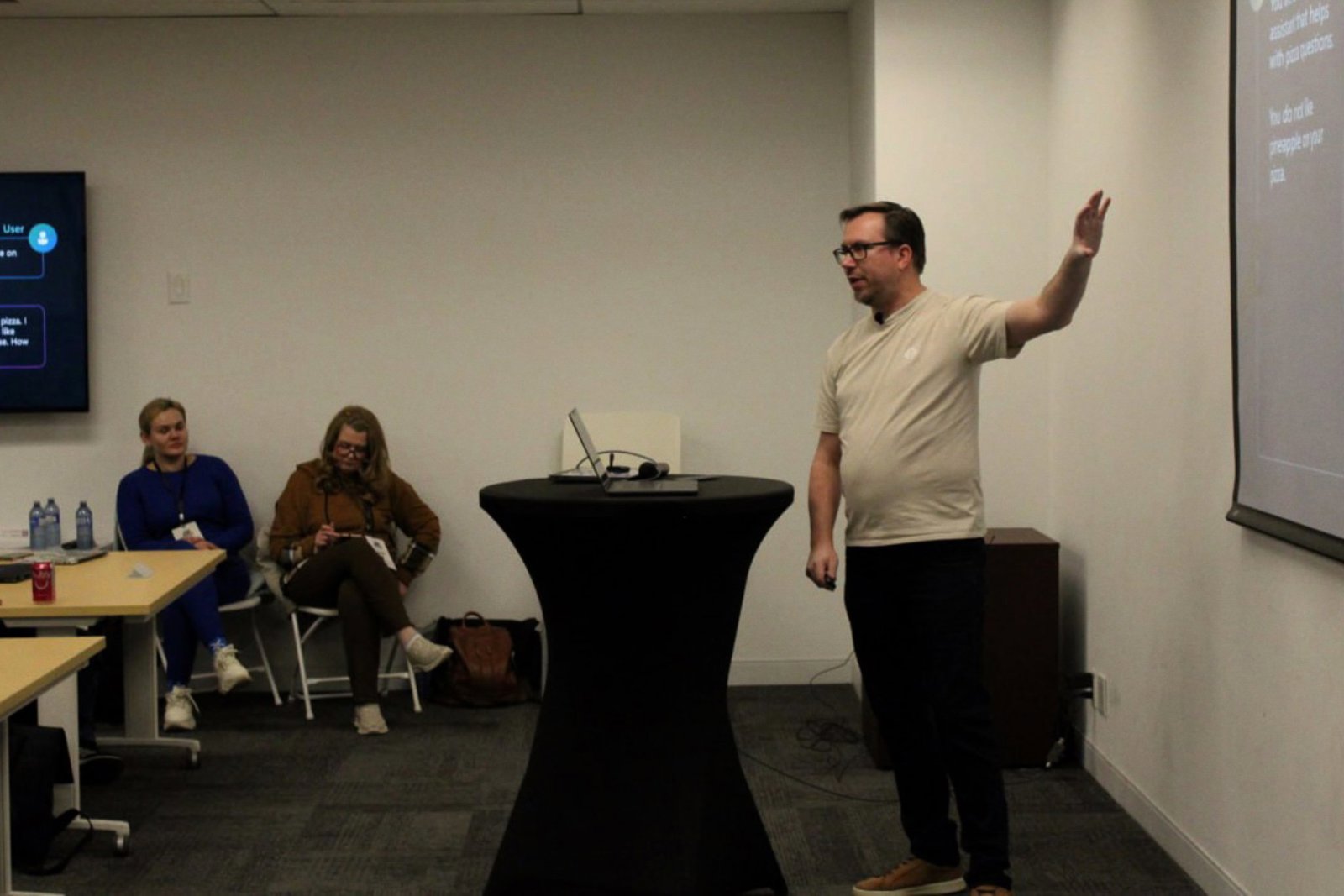
Breakout room ·Build a Pizza Ordering Agent with Microsoft Foundry and MCP
In this hands-on workshop, you’ll learn to build domain-specific AI agents with Foundry Agent Service. Starting from a simple agent, you’ll add system prompts, custom instructions, and knowledge with RAG. You’ll extend it with tool calling (like a pizza calculator) and connect external services via MCP for live menu and order handling. By the end, you’ll have a working Contoso PizzaBot that can answer questions, recommend pizzas, and manage orders.
Henk is a Cloud Advocate specializing in Artificial intelligence and Azure with a background in application development. He is currently part of the AI cloud advocate team and based in the Netherlands. Before joining Microsoft, he was a Microsoft AI MVP and worked as a software developer and architect building lots of AI powered platforms on Azure.
Closing Raffle
We're closing out with a bang, join us for the raffle and quiz for a chance to win some fantastic prizes!
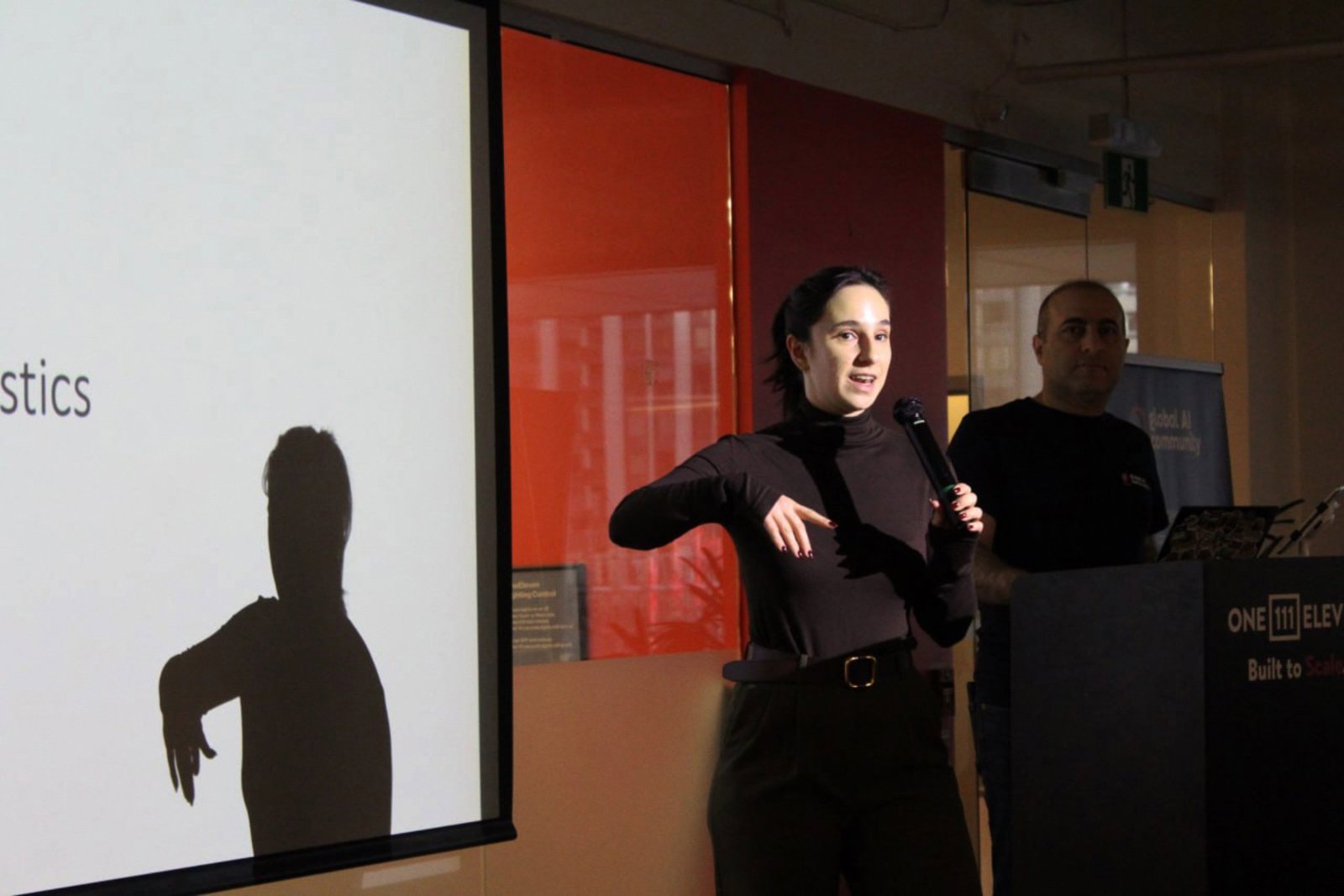
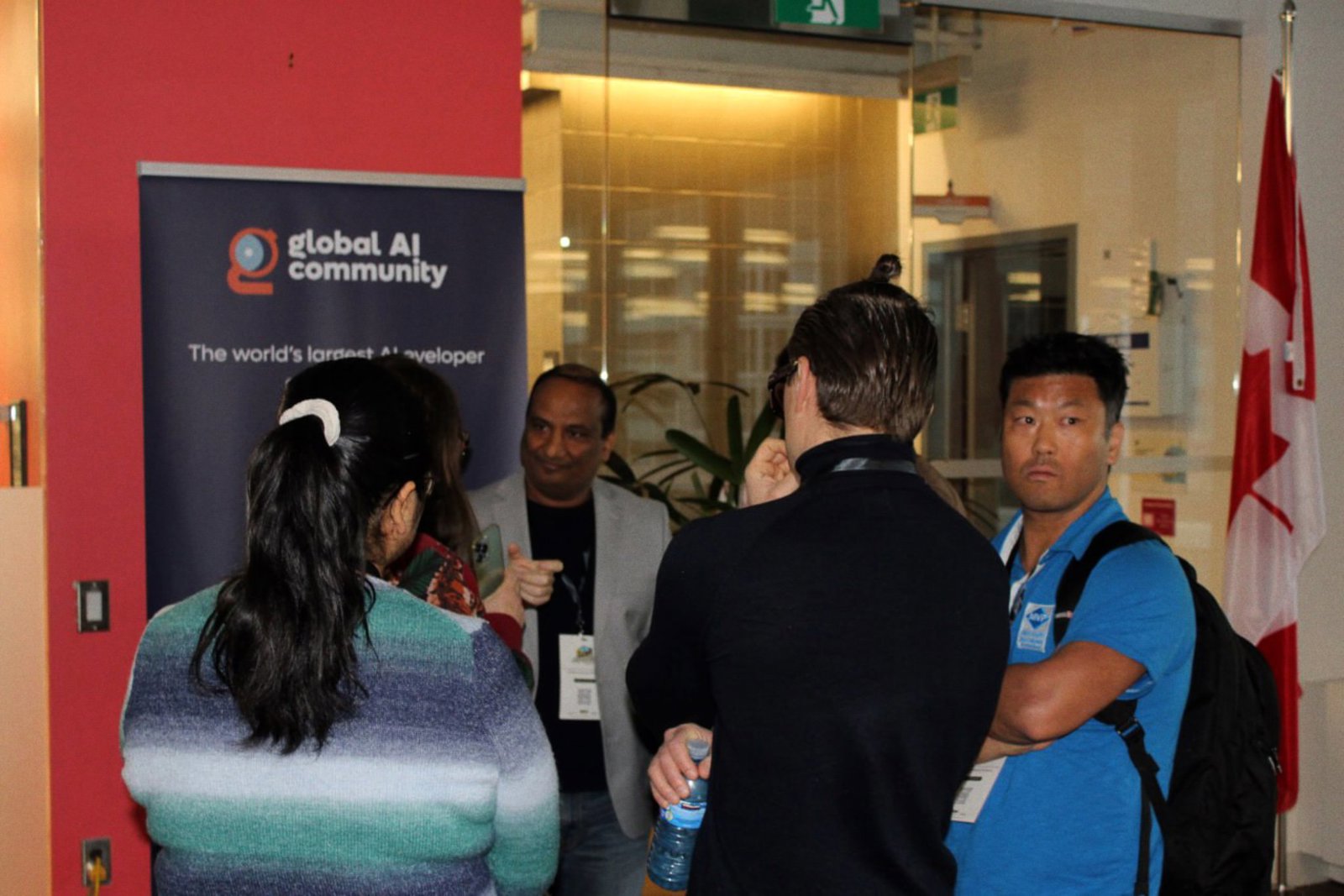
This is how it looked


Made possible by
Made possible by:



Explore AgentCon
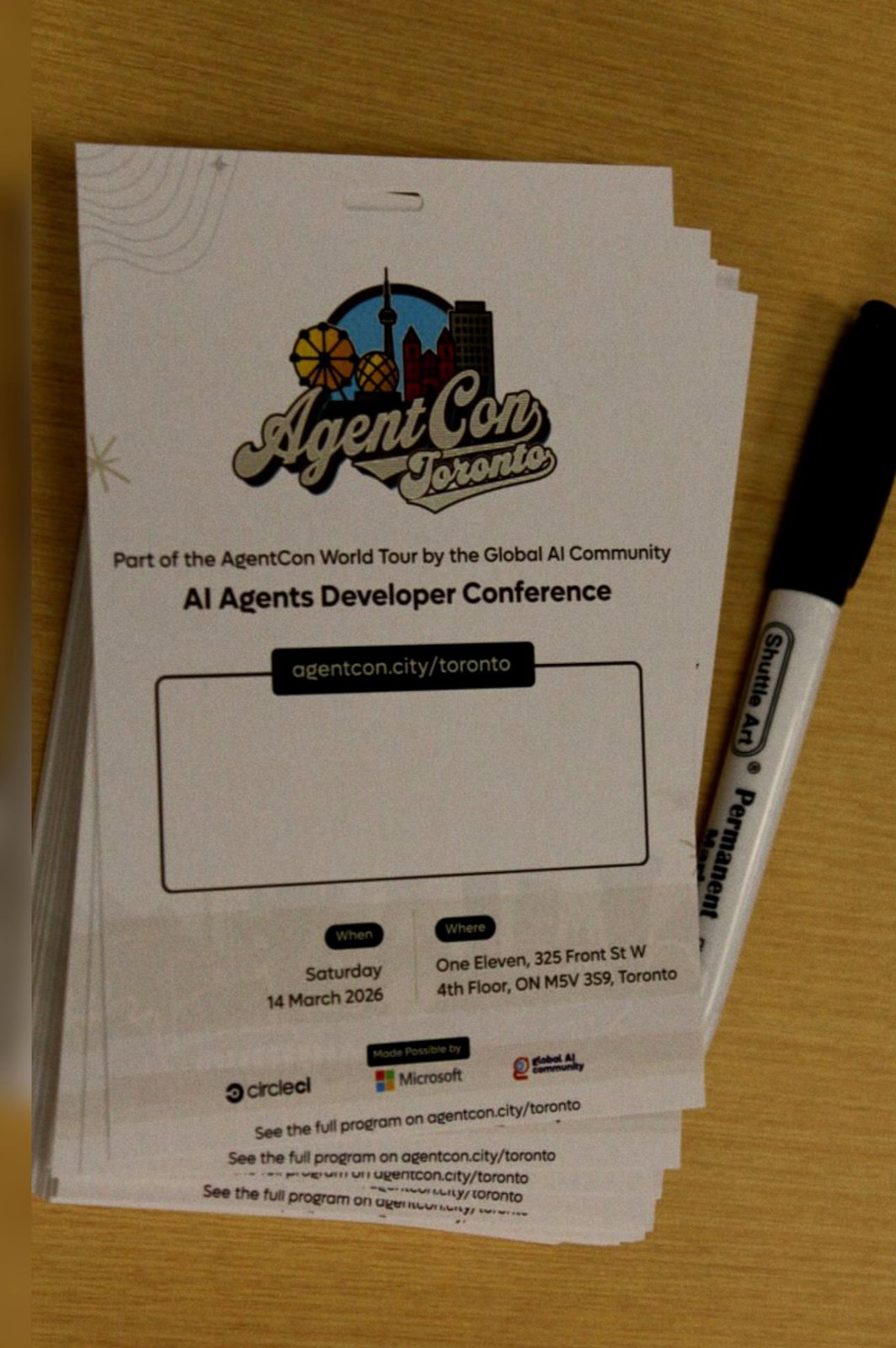
AI Agents Developer Conference
AgentCon made possible by: