/Events /AgentCon - Bangkok
AgentCon - Bangkok
This event is part of AgentCon, organized by Global AI Bangkok.
Schedule
About
Join us for the AI Agents World Tour, a global series of one-day conferences designed exclusively for developers building the future with AI agents.
From San Francisco to Thailand, we’re bringing together leading engineers, researchers, and creators to explore the cutting edge of AI agent design, deployment, and integration. Whether you’re building intelligent assistants, autonomous systems, or next-gen developer tools, this event is your fast track to practical knowledge, hands-on demos, and real-world insights.
What to Expect:
- Deep-Dive Talks from AI pioneers and industry leaders
- Technical Workshops on building, deploying, and scaling agents
- Live Demos of powerful open-source frameworks and tools
- Networking with a global community of builders and innovators
This isn't just another AI event — it’s where developers meet to talk about real code.
Ready to build the future?
Who's on stage
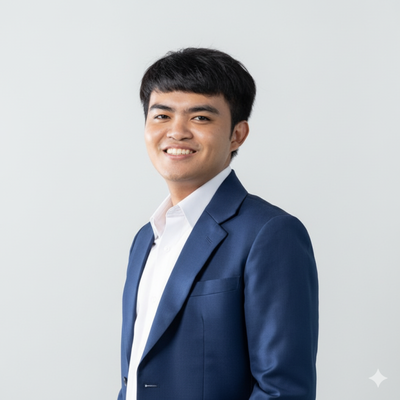
Solutions Architect at Amazon Web Services

Pratima Upadhyay is an experienced Software Engineer with over 6.5 years of experience building large-scale distributed systems and enterprise platforms. She specializes in backend and full-stack development, microservice architectures, cloud computing, RESTful APIs, system design, and test-driven development, with a strong focus on scalability, reliability, and security. She currently works at Airbnb, where she builds secure, resilient payments and compliance platforms that operate at global scale, supporting complex, regulated workflows across financial crime, KYC, and risk systems. Her work involves designing production-grade systems that balance performance, safety, and auditability in high-risk environments. Previously, Pratima worked at Microsoft, contributing to the Microsoft Cloud Platform, where she gained deep experience in distributed systems, cloud storage and computing, and enterprise-grade infrastructure. Beyond her engineering role, Pratima is deeply invested in mentorship and community building. She has mentored 50+ individuals on career guidance, interview preparation, and resume building, drawing from her own experience of interviewing with 30+ companies globally and conducting interviews for 50+ engineers. She is also a Women in Tech ambassador, working long-term with women aspiring to build careers in big tech. Pratima is a technical blogger and educator, running her own ed-tech platform where she teaches Software Engineering and System Design fundamentals, helping engineers develop strong problem-solving and architectural thinking skills. She regularly shares practical insights from real-world systems through her writing and talks. 🔗 System Design Course: https://pratimaupadhyay.graphy.com/courses/System-Design-Fundamentals-63a42ab5e4b06b001362deda 🔗 Blog / Newsletter: https://www.linkedin.com/newsletters/all-about-software-engineering-6989928278610378752/

I am the co-founder and Chief Product Officer of WISESIGHT, a data analytics company and Also. Google Developers Experts for Web Technologies I'm focusing on Web performance & Web capabilities.
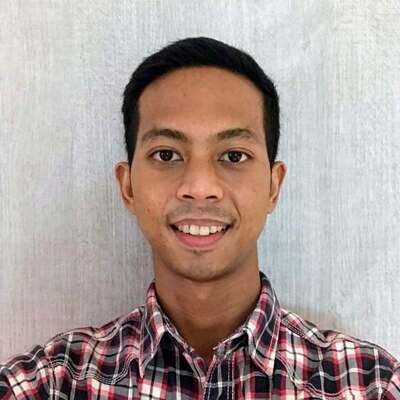
Songpol Bunyang is a Research Engineer at Botnoi, a Thai AI startup focused on building production-grade conversational AI and agentic systems. He is also pursuing a PhD at SIIT, where his research focuses on adaptive self-design multi-agent systems for changing and evolving task environments.
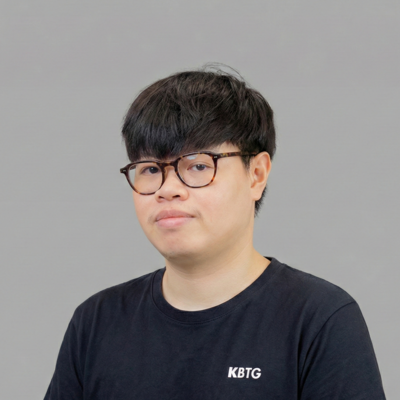
Danupat Khamnuansin is an AI Research Engineer dedicated to developing LLM-powered chatbots and AI agents for the financial and banking industry. He has deep expertise in architecting secure RAG systems and agentic AI, with a primary focus on the complexities of production-scale deployment in highly regulated environments.

Christian Glessner is the founder of Hololux, an innovation agency at the intersection of artificial intelligence and immersive technology. As a 17-year Microsoft Most Valuable Professional (MVP) and early contributor to Microsoft’s new Agent Framework, he explores how multi-agent orchestration and graph intelligence are shaping the future of enterprise automation. A German Innovation Award 2024 winner, Christian bridges advanced AI concepts with real-world business impact. Known for his energetic, demo-driven presentations, he makes complex agent architectures tangible and inspires teams to build smarter, connected systems.

Henk is a Cloud Advocate specializing in Artificial intelligence and Azure with a background in application development. He is currently part of the AI cloud advocate team and based in the Netherlands. Before joining Microsoft, he was a Microsoft AI MVP and worked as a software developer and architect building lots of AI powered platforms on Azure.
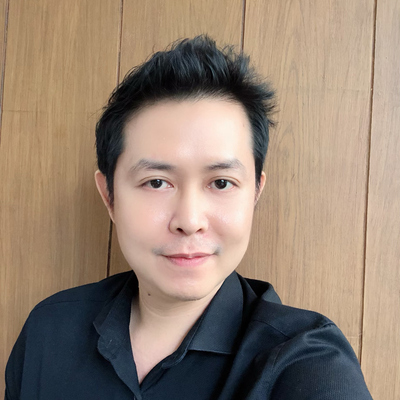
Sathapon Patanakuha is a serial entrepreneur and the CEO of Guardian AI, an award-winning AI agent solution for enterprises. With 20 years of experience in enterprise IT and 5 years as a tech startup CEO, Sathapon combines deep technical expertise with strategic business insight. Holding a degree in Computer Engineering, he has established himself as a trusted technology partner, helping organizations integrate AI technology into real-world business applications. Under his leadership, Guardian AI has pioneered innovative AI agent solutions, empowering enterprises to enhance efficiency, drive innovation, and accelerate growth. Beyond his entrepreneurial role, Sathapon serves as an Advisor on the National AI Strategy Committee at the Parliament of Thailand, a Board Member at the AI Entrepreneur Association of Thailand (AIEAT), Research Fellow at the AI Governance Center, and AI Alliance Ambassador – Thailand. In these capacities, he actively contributes to shaping responsible and forward-thinking AI policies that balance technological advancement with ethical and societal impact.
A hyper productivity seeker. I spend every passing day seeking factors which affect human productivity. I enjoy writing code but I will do whatever necessary to deliver value to clients. I can deploy server (given there are scripts properly prepared). I can test a feature. I love to give talks. I love when the others are inspired to be more productive. Discussing about human productivity with my audiences after talks usually make me thrilled, especially the looks in their eyes.

Dmitry Katson is a 🏆 Microsoft MVP 🏆 Contribution Hero and Founder of CentralQ.ai, an AI-powered knowledge and agent platform built for the Business Central. With over 20 years of experience, he is recognized for turning ideas into real-world AI solutions — from copilots to autonomous agents. Dmitry focuses on bringing human and machine intelligence together to create agents that understand, analyze, and act inside Business Central. A frequent speaker at Directions, BC TechDays, and global AI events, he continues to push the boundaries of what’s possible when AI meets enterprise systems.
Sr. Solution Engineer at Microsoft

Mihail Mateev is an owner, Solution Architect, Senior Technical Evangelist at SoftProject, responsible for .Net, IoT and cloud solutions. Mihail currently works as a Senior Solution Architect at EPAM Systems. He also worked many years like a Technical evangelist in the Infragistics. Last years Mihail was focused on various areas related to technology Microsoft: Visual Studio , ASP.Net, Windows client apps, MS SQL Server and Microsoft Azure.

I'm a tech consultant and coding evangelist at BorntoDev, a platform for learning about technology and software development. I'm passionate about learning new technologies and am a regular speaker at tech conferences, an author, and a Youtuber.
Cyrus Wong is an accomplished senior lecturer who oversees the Higher Diploma program in Cloud and Data Centre Administration at the Hong Kong Institute of Information Technology (HKIIT) at IVE(Lee Wai Lee) in Hong Kong. He is a passionate advocate for the adoption of cloud technology across various media and events. With his extensive knowledge and expertise, he has earned prestigious recognitions such as AWS AI Hero, Microsoft MVP - Azure AI, and Google Developer Expert for AI & Google Cloud Platform. 黃俊彥是香港香港資訊科技學院(HKIIT)位於 IVE(李惠利)資訊科技系雲端系統及數據中心管理高級文憑的高級講師,擁有豐富的知識和專業技能。他熱衷於在各種媒體和活動中推廣雲端技術。由於他的專業知識和專業技能,他獲得亞馬遜雲端運算服務AI英雄、微軟Azure AI最有價值專家和Google AI & 雲端平台的Google開發者專家等著名榮譽稱號,是世上唯一能夠獲得IT業界三巨頭同時公認的專家。
Napol Hengbumrung is a Microsoft MVP specializing in Power Platform, Data Analytics, and AI adoption. With over 11 years of experience across various industries, Napol is passionate about digital transformation, data-driven decision-making, and empowering organizations to leverage AI technologies effectively. He has extensive experience in project management, Lean Six Sigma, and digital marketing, and has been instrumental in building citizen developers through low-code technologies. Napol is also the founder of the Microsoft Copilot Community Thailand, the lead of the AILY project (AI Transformations in SCGC), and the founder of the Microsoft Power Platform Bootcamp in Thailand, which has been successfully conducted for 1st to 4th generations, driving AI adoption and innovation across the organization. As a visiting professor and founder of Ducky Engineer, he provides consulting and training in data analytics, Power Platform, and digital transformation initiatives, helping organizations align processes and enhance productivity in a rapidly changing world.
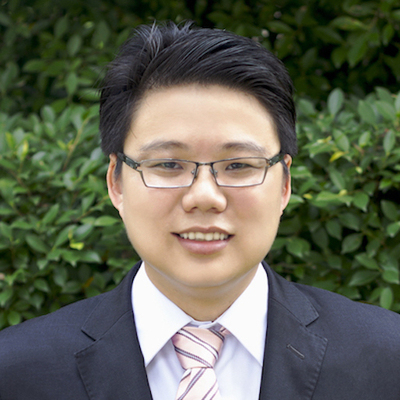
Dr. Kobkrit Viriyayudhakorn is the Founder & CEO of iApp Technology and President of the Artificial Intelligence Entrepreneurs Association of Thailand (AIEAT). He holds a Ph.D. in Knowledge Science with Excellent Thesis Award from Japan Advanced Institute of Science and Technology (JAIST). As a leading figure in Thailand's AI industry, he spearheads OpenThaiGPT—Thailand's open-source large language model—and develops enterprise AI solutions including Chinda RAG Chatbot, Thai OCR, and AI Legal Assistant. His mission is to advance Thai Sovereign AI and position Thailand as a regional leader in artificial intelligence.

Gittitat is a software engineer and game developer who obtained Unity Certified Professional: Programmer from Unity. With a background in Game Development and AR/VR Development, Gittitat is passionate about sharing his knowledge with others. He has a keen interest in learning more about Computer Graphics, Optimization, Machine Learning on Unity. He also manages a small Facebook fan page This is Unity where he shares knowledge about shaders and Unity tips and tricks with the community. Additionally, Gittitat has been a speaker at .Net Conf Thailand for several years
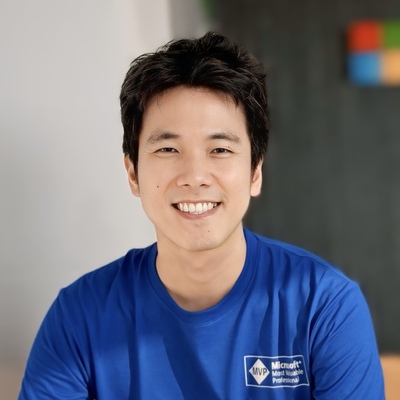
Microsoft MVP in the AI field for 6 years. A developer who loves to find the easiest and best method to finish the work.
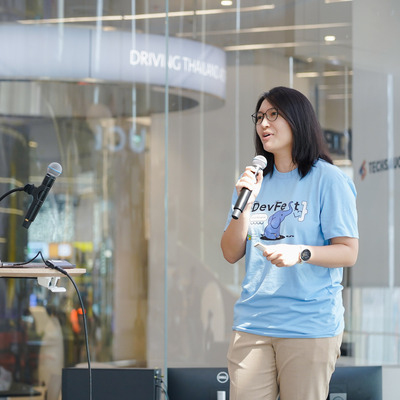
Kamolphan Liwprasert (Fon) is an experienced ML Engineer, Data Engineer, and Cloud enthusiast focused on building practical AI systems. She currently works as the Data Team Lead at AIMET, an AI for Mental Health center. She actively contributes to the tech community through her roles as a Google Developer Expert in Cloud, a GDG Cloud Bangkok organizer, and a Women Techmakers ambassador.

As a Developer Advocate at Neo4j, I help developers harness the power of graph technology and AI. A Microsoft MVP and global speaker at events like TED, Microsoft Build, and WeAreDevelopers, I focus on making complex tech accessible through content, community, and hands-on support. My mission is to connect, empower, and inspire developers to build impactful solutions.
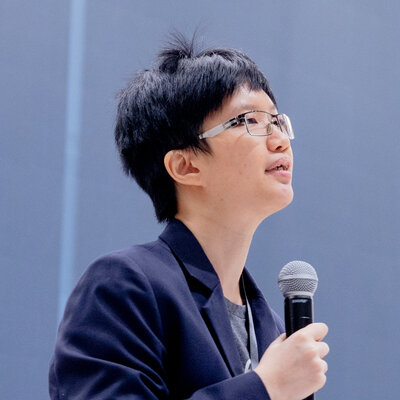
I'm a systems engineer by background. Been doing platform engineering / cloud cost optimization before there's a term for it.
A student in Computer Engineering (International Program) at King Mongkut’s University of Technology Thonburi (KMUTT), who really got inspired about technologies, especially on Data Science and Machine Learning. Additionally, being a part of Microsoft Learn Student Ambassadors, as the young technology evangelist among big technological industries and universities partners.

Data scientist and AI Engineer expert with over 5 years of experience in the AI, Data & Robotics fields. A developer behind various national-level AI & Data Solutions innovations, including Generative AI technologies such as Large Language Models, Multimodal, and Multi-Agent systems.

Stephen SIMON is a Program Manager at the Global AI Community and a Microsoft MVP in AI, recognized for his hands-on work in applied AI systems, developer enablement, and large-scale program execution. He works at the intersection of AI engineering and program leadership, helping teams and communities design, build, and scale real-world AI solutions. His expertise spans AI agents, multi-agent systems, Model Context Protocols (MCPs), cloud-native AI architectures, and production-grade LLM applications. As a global speaker, he has delivered sessions at conferences including Experts Live Europe, WOW Summit Hong Kong, and AgentCon Istanbul, where he speaks on topics such as AI agents in production, modern AI architectures, cloud-native AI systems, and the future of developer tooling. Beyond product and platform work, Stephen has built and scaled some of the largest developer communities and programs in the region.
Sessions & tracks
Registration
Main Stage (150) | K Plus Stadium (3rd Fl.) ·Welcome and opening
Main Stage (150) | K Plus Stadium (3rd Fl.) ·Agents of Tomorrow: Building the Next Generation of Intelligence
We stand at the edge of a profound shift in artificial intelligence. Over the last five years, generative AI has moved from novelty to necessity—transforming how we create, code, and collaborate. Now, a new frontier is emerging: AI agents. Unlike traditional tools that wait for instructions, agents can perceive, decide, and act toward goals—expanding the boundaries of what humans and machines can achieve together.
In this keynote, we’ll explore the evolution from copilots to fully agentic systems, highlight breakthroughs that are reshaping industries, and imagine the future horizons where autonomous agents redefine productivity, creativity, and discovery. Most importantly, we’ll discuss the role of humans in this new era—not as bystanders, but as leaders guiding how agents operate, align with our values, and amplify our potential.
The Agents of Tomorrow are here—and the future will be built by those bold enough to partner with them.
Henk is a Cloud Advocate specializing in Artificial intelligence and Azure with a background in application development. He is currently part of the AI cloud advocate team and based in the Netherlands. Before joining Microsoft, he was a Microsoft AI MVP and worked as a software developer and architect building lots of AI powered platforms on Azure.
From Intents to Agents: An Enterprise Chatbot Journey Across Three AI Eras
This session shares a hands-on journey of building and evolving enterprise chatbots in the banking domain, from intent-based systems using traditional ML and deep learning to generative and agentic AI architectures.
The speaker discusses how these systems were built, updated, and maintained in production, highlighting key trade-offs, pros and cons, and operational considerations across different chatbot generations.
Attendees will gain practical guidance for developers on what to modernize, what to keep, and what to redesign when adopting generative AI for enterprise chatbot systems.
Danupat Khamnuansin is an AI Research Engineer dedicated to developing LLM-powered chatbots and AI agents for the financial and banking industry. He has deep expertise in architecting secure RAG systems and agentic AI, with a primary focus on the complexities of production-scale deployment in highly regulated environments.
Gemini AI Classroom Assistant: AI Agent Orchestration for Smarter Digital Learning
How can one teacher effectively monitor 75 screens in a computer lab? At HKIIT, we solved this challenge by building the Gemini AI Classroom Assistant, an AI Agent-powered system leveraging Vertex AI Gemini 3.0 and orchestrated with GenKit on Google Cloud. This talk explores how specialized AI Agents collaborate to transform classroom management:
Invigilator Agent: Detects unauthorized apps, AI chat tools, and academic dishonesty in real time. Wellness Coach Agent: Monitors engagement, frustration, and progress to provide proactive support. Analysis Agents: Process multimodal inputs (screenshots, videos) and trigger tools for messaging, irregularity logging, and progress tracking.
We’ll showcase how these AI Agents interact through serverless flows, leveraging Firebase, Cloud Functions, and Firestore for scalable, secure orchestration. Expect a live demo of agent-driven interventions and insights that empower teachers to focus on teaching while AI handles compliance and welfare. Key Takeaways:
Understand how AI Agents redefine classroom monitoring and engagement. Explore agent roles and tool orchestration using GenKit. Learn the architecture behind real-time multimodal analysis at scale. See how AI Agents collaborate to deliver actionable insights for educators.
Cyrus Wong is an accomplished senior lecturer who oversees the Higher Diploma program in Cloud and Data Centre Administration at the Hong Kong Institute of Information Technology (HKIIT) at IVE(Lee Wai Lee) in Hong Kong. He is a passionate advocate for the adoption of cloud technology across various media and events. With his extensive knowledge and expertise, he has earned prestigious recognitions such as AWS AI Hero, Microsoft MVP - Azure AI, and Google Developer Expert for AI & Google Cloud Platform. 黃俊彥是香港香港資訊科技學院(HKIIT)位於 IVE(李惠利)資訊科技系雲端系統及數據中心管理高級文憑的高級講師,擁有豐富的知識和專業技能。他熱衷於在各種媒體和活動中推廣雲端技術。由於他的專業知識和專業技能,他獲得亞馬遜雲端運算服務AI英雄、微軟Azure AI最有價值專家和Google AI & 雲端平台的Google開發者專家等著名榮譽稱號,是世上唯一能夠獲得IT業界三巨頭同時公認的專家。
Lunch
Main Stage (150) | K Plus Stadium (3rd Fl.) ·Agentic DevOps: AI-Native SDLC Transformation with GitHub
Let's learn how to get started with AI enhanced development features in GitHub, how to take the best advantage of them in your day-to-day development work, and modernize your DevOps strategy with Agentic DevOps.
- SDLC Transformation with AI
- Agent HQ
- AI Code Security & Quality
- Enterprise Grade Platform & Governance
Sr. Solution Engineer at Microsoft
The Agentic Commerce Stack: From Prompt to Payment
In my previous talk on Agentic Commerce at AI Community Day Bangkok, I introduced the concept with a high-level overview and a short demo.
At AgentCon Bangkok, I would like to go deeper. This session breaks down the end-to-end architecture that turns a user prompt into a verified transaction. I will walk through the core layers of agentic commerce—intent understanding, planning, tool execution, verification, and payment—and share real-world patterns, constraints, and failure modes from building production systems.
This talk is for builders who want to move beyond demos and start shipping reliable, scalable agent-driven commerce.
Sathapon Patanakuha is a serial entrepreneur and the CEO of Guardian AI, an award-winning AI agent solution for enterprises. With 20 years of experience in enterprise IT and 5 years as a tech startup CEO, Sathapon combines deep technical expertise with strategic business insight. Holding a degree in Computer Engineering, he has established himself as a trusted technology partner, helping organizations integrate AI technology into real-world business applications. Under his leadership, Guardian AI has pioneered innovative AI agent solutions, empowering enterprises to enhance efficiency, drive innovation, and accelerate growth. Beyond his entrepreneurial role, Sathapon serves as an Advisor on the National AI Strategy Committee at the Parliament of Thailand, a Board Member at the AI Entrepreneur Association of Thailand (AIEAT), Research Fellow at the AI Governance Center, and AI Alliance Ambassador – Thailand. In these capacities, he actively contributes to shaping responsible and forward-thinking AI policies that balance technological advancement with ethical and societal impact.
"Automation-first" with Microsoft Foundry Agent Service
This session aims to shift the audience's perspective from AI as a chat tool to AI as an autonomous system. We will demonstrate how to move beyond manual prompting by using Microsoft Foundry to build "Agentic Workflows"—systems that trigger themselves, reason through complex data via Foundry IQ, and execute actions across enterprise apps.
Microsoft MVP in the AI field for 6 years. A developer who loves to find the easiest and best method to finish the work.
A Lightweight AI Agent System I Use Every Day at MOHARA
In a real production environment, AI agents do not need to be impressive. They need to be useful, predictable, and easy to reason about when something goes wrong.
In this session, I will share a lightweight AI agent system I use every day at work. It is based on practical patterns learned from building and operating AI-assisted workflows in a professional setting, under real constraints like time, reliability, and team expectations.
Instead of focusing on full autonomy or complex orchestration, this approach emphasizes clear agent roles, controlled autonomy, and keeping a human in the loop at the right points. I will walk through how the system is structured, the types of daily tasks it supports, and why lightweight agent designs have worked better in real-world development and decision-making.
The talk focuses on practical concerns that matter in everyday work. These include deciding which tasks are worth turning into agents, designing agent behavior that stays safe and predictable, and integrating agents into existing workflows without disrupting productivity. The session is framework-agnostic and based on real usage, so attendees can apply the ideas directly in their own environments.
Gittitat is a software engineer and game developer who obtained Unity Certified Professional: Programmer from Unity. With a background in Game Development and AR/VR Development, Gittitat is passionate about sharing his knowledge with others. He has a keen interest in learning more about Computer Graphics, Optimization, Machine Learning on Unity. He also manages a small Facebook fan page This is Unity where he shares knowledge about shaders and Unity tips and tricks with the community. Additionally, Gittitat has been a speaker at .Net Conf Thailand for several years
Break
Main Stage (150) | K Plus Stadium (3rd Fl.) ·Browser-Bound: Building On-Device AI Chatbot
The cloud isn’t the only place for Intelligence anymore. As privacy concerns grow and latency becomes a critical bottleneck, the browser is evolving into a powerful execution environment for LLMs. This session explores the paradigm shift of on-device AI, demonstrating how to build a fully functional chatbot that runs entirely within the user's browser. We will cover the benefits of local execution—including cost reduction and ironclad privacy—and discuss the current state of web-based AI frameworks.
I am the co-founder and Chief Product Officer of WISESIGHT, a data analytics company and Also. Google Developers Experts for Web Technologies I'm focusing on Web performance & Web capabilities.
How to Make an Accurate Legal Thai Chatbot Assistant for Thai Government Organizations?
Building AI chatbots that handle legal queries in Thai presents unique challenges—from the complexities of Thai natural language processing to the precision required for government compliance. In this session, Dr. Kobkrit Viriyayudhakorn shares hard-won lessons from deploying production-ready legal chatbot assistants for Thai government organizations.
Drawing from real-world implementations, this talk covers the end-to-end architecture of building accurate, reliable Thai legal assistants. You'll learn how to leverage agentic AI patterns with tool calling to retrieve relevant legal documents, handle ambiguous Thai queries, and provide verifiable answers that government agencies can trust.
Key topics include optimizing Thai language models for legal domain accuracy, implementing page-level indexing for precise document retrieval, and designing agent workflows that know when to search, when to clarify, and when to escalate. Whether you're building for government, enterprise, or public-facing applications, you'll walk away with practical strategies for deploying Thai AI assistants that actually work.
Dr. Kobkrit Viriyayudhakorn is the Founder & CEO of iApp Technology and President of the Artificial Intelligence Entrepreneurs Association of Thailand (AIEAT). He holds a Ph.D. in Knowledge Science with Excellent Thesis Award from Japan Advanced Institute of Science and Technology (JAIST). As a leading figure in Thailand's AI industry, he spearheads OpenThaiGPT—Thailand's open-source large language model—and develops enterprise AI solutions including Chinda RAG Chatbot, Thai OCR, and AI Legal Assistant. His mission is to advance Thai Sovereign AI and position Thailand as a regional leader in artificial intelligence.
Graph-Based AI for High-Risk Decisions: Inside Modern Compliance Investigations
Compliance investigations operate at massive scale and extreme complexity. Every case type, whether it is sanctions, financial crime, or KYC, comes with its own policies, decision trees, and data sources. For human agents, this means navigating fragmented tools, dense rulebooks, and high-risk decisions under time pressure.
In this session, I’ll walk through the design of an AI-powered investigation recommendation engine built using LangGraph to orchestrate large language models, policy logic, and internal case systems. Instead of relying on static playbooks, the system models investigations as stateful workflows that understand which stage a case is in, validate actions against compliance rules, and recommend the next best step for the agent to take.
You’ll see how we use graph-based LLM orchestration to handle branching logic, evidence gathering, and policy enforcement, while safely connecting the model to internal tools, case data, and risk signals. This allows the AI to reason over both unstructured text and structured compliance data in a controlled, auditable way.
The talk focuses on the system architecture, data flow, and safety constraints required to bring AI into high-risk, regulated workflows, showing how we moved from brittle prompts to a production-ready, trustworthy decision support system for investigators.
If you’re building AI agents for compliance, risk, finance, or any complex enterprise workflow, this session will give you a blueprint for designing systems that scale beyond chatbots into real operational intelligence.
Pratima Upadhyay is an experienced Software Engineer with over 6.5 years of experience building large-scale distributed systems and enterprise platforms. She specializes in backend and full-stack development, microservice architectures, cloud computing, RESTful APIs, system design, and test-driven development, with a strong focus on scalability, reliability, and security. She currently works at Airbnb, where she builds secure, resilient payments and compliance platforms that operate at global scale, supporting complex, regulated workflows across financial crime, KYC, and risk systems. Her work involves designing production-grade systems that balance performance, safety, and auditability in high-risk environments. Previously, Pratima worked at Microsoft, contributing to the Microsoft Cloud Platform, where she gained deep experience in distributed systems, cloud storage and computing, and enterprise-grade infrastructure. Beyond her engineering role, Pratima is deeply invested in mentorship and community building. She has mentored 50+ individuals on career guidance, interview preparation, and resume building, drawing from her own experience of interviewing with 30+ companies globally and conducting interviews for 50+ engineers. She is also a Women in Tech ambassador, working long-term with women aspiring to build careers in big tech. Pratima is a technical blogger and educator, running her own ed-tech platform where she teaches Software Engineering and System Design fundamentals, helping engineers develop strong problem-solving and architectural thinking skills. She regularly shares practical insights from real-world systems through her writing and talks. 🔗 System Design Course: https://pratimaupadhyay.graphy.com/courses/System-Design-Fundamentals-63a42ab5e4b06b001362deda 🔗 Blog / Newsletter: https://www.linkedin.com/newsletters/all-about-software-engineering-6989928278610378752/
Closing and networking
Registration
Breakout (70) | Intelligence and Insight (G Fl.) ·Welcome and opening
Breakout (70) | Intelligence and Insight (G Fl.) ·Agents of Tomorrow: Building the Next Generation of Intelligence
We stand at the edge of a profound shift in artificial intelligence. Over the last five years, generative AI has moved from novelty to necessity—transforming how we create, code, and collaborate. Now, a new frontier is emerging: AI agents. Unlike traditional tools that wait for instructions, agents can perceive, decide, and act toward goals—expanding the boundaries of what humans and machines can achieve together.
In this keynote, we’ll explore the evolution from copilots to fully agentic systems, highlight breakthroughs that are reshaping industries, and imagine the future horizons where autonomous agents redefine productivity, creativity, and discovery. Most importantly, we’ll discuss the role of humans in this new era—not as bystanders, but as leaders guiding how agents operate, align with our values, and amplify our potential.
The Agents of Tomorrow are here—and the future will be built by those bold enough to partner with them.
Henk is a Cloud Advocate specializing in Artificial intelligence and Azure with a background in application development. He is currently part of the AI cloud advocate team and based in the Netherlands. Before joining Microsoft, he was a Microsoft AI MVP and worked as a software developer and architect building lots of AI powered platforms on Azure.
How to Stay Sane in the Age of Agents
The agentic AI landscape moves very fast, amidst the ever-changing landscape, I will share how to setup and structure your agentic projects to make it stable and operational. By utilizing AIOps and DevOps, with borrowed practices from data engineering, agentic projects would be more robust and able to withstand the test of time.
I'm a systems engineer by background. Been doing platform engineering / cloud cost optimization before there's a term for it.
Why Multi-Agent Systems? Designing Collaborative AI for Real Products
Multi-AI agent systems are rapidly evolving from research concepts into production-grade architectures—but why do we need multiple agents, and how can they collaborate effectively in real-world products?
This session explores the core motivations behind multi-agent architectures, highlighting scenarios where even a powerful single LLM or standalone agent falls short. We will examine how task decomposition, agent specialization, and structured coordination enable greater scalability, resilience, and tangible business value.
The talk includes a live demo of the Botnoi agentic builder platform, demonstrating how AI agents can be designed, orchestrated, and integrated into real products. Drawing from production use cases at a Thai AI startup, we will show how an agentic builder platform accelerates development velocity, improves operational efficiency, and drives measurable business outcomes.
Attendees will walk away with:
- A clear mental model for when and why to adopt multi-agent systems
- Practical collaboration and orchestration patterns applicable to real-world products
- Insights into building agentic systems that scale from prototypes to business-critical workflows
- A concrete example of how agentic platforms translate technical architecture into business impact
Songpol Bunyang is a Research Engineer at Botnoi, a Thai AI startup focused on building production-grade conversational AI and agentic systems. He is also pursuing a PhD at SIIT, where his research focuses on adaptive self-design multi-agent systems for changing and evolving task environments.
Lunch
Breakout (70) | Intelligence and Insight (G Fl.) ·Multi-Agent Systems in Business
AI agents aren’t sci-fi anymore — they’re already solving real business problems today. In this session, we’ll go beyond theory and show how multi-agent systems can collaborate to extract insights from live business data using the Agent Framework and ERP (Business Central) API's + MCP.
We’ll build a real working agentic system step by step, connect it to business data, and show how agents talk, think, and act — with tools, memory, and knowledge. Then comes the fun part: a live “Agent vs. Human” challenge, where our agent team goes head-to-head with a brave audience member to answer questions using nothing but documentation (and brains).
If you’re building agent-powered enterprise apps or just curious how far we can push the agent stack — join us for an entertaining, technical, and practical tour of what agents can already do today.
Dmitry Katson is a 🏆 Microsoft MVP 🏆 Contribution Hero and Founder of CentralQ.ai, an AI-powered knowledge and agent platform built for the Business Central. With over 20 years of experience, he is recognized for turning ideas into real-world AI solutions — from copilots to autonomous agents. Dmitry focuses on bringing human and machine intelligence together to create agents that understand, analyze, and act inside Business Central. A frequent speaker at Directions, BC TechDays, and global AI events, he continues to push the boundaries of what’s possible when AI meets enterprise systems.
Building Tool-Driven AI with Claude and MCP
Tool integration remains one of the biggest bottlenecks in building reliable AI agents. Even with powerful models like Claude, connecting models to tools, data, and services often relies on brittle, hard-coded logic.
This session shows how the Model Context Protocol (MCP) can be used with Claude to create clean, maintainable, and tool-driven AI systems. We will explore MCP from a developer perspective, build a minimal MCP server, and demonstrate how Claude dynamically discovers.
Stephen SIMON is a Program Manager at the Global AI Community and a Microsoft MVP in AI, recognized for his hands-on work in applied AI systems, developer enablement, and large-scale program execution. He works at the intersection of AI engineering and program leadership, helping teams and communities design, build, and scale real-world AI solutions. His expertise spans AI agents, multi-agent systems, Model Context Protocols (MCPs), cloud-native AI architectures, and production-grade LLM applications. As a global speaker, he has delivered sessions at conferences including Experts Live Europe, WOW Summit Hong Kong, and AgentCon Istanbul, where he speaks on topics such as AI agents in production, modern AI architectures, cloud-native AI systems, and the future of developer tooling. Beyond product and platform work, Stephen has built and scaled some of the largest developer communities and programs in the region.
From Agentic AI to Physical AI
This session explores the progression from foundational machine learning concepts to the future of embodied artificial intelligence. We begin with the core of machine learning, which learns to predict answers, and move to the role of Large Language Models (LLMs) in understanding questions and responding to diverse instructions.
Building upon this, we examine the AI Agent, which utilizes its understanding of context and history from an LLM to plan and execute actions, either independently or with external tools. The discussion then advances to the next frontier: building AgenticAI to comprehend, plan, simulate, and act within the real-world environment, a concept we define as "PhysicalAI." This emerging field of PhysicalAI opens possibilities for sophisticated simulation and planning to recommend actions or guide a human-in-the-loop.
Data scientist and AI Engineer expert with over 5 years of experience in the AI, Data & Robotics fields. A developer behind various national-level AI & Data Solutions innovations, including Generative AI technologies such as Large Language Models, Multimodal, and Multi-Agent systems.
Unlocking Context Engineering with Microsoft Foundry and Neo4j
Most AI agents lose context fast. In this session, you’ll learn how to connect Neo4j with your AI agent stack to give your assistants lasting, dynamic memory.
Through guided exercises, you’ll model relationships, store conversation history, and query relevant context to make your agent smarter over time. See how graph databases provide the missing layer of cognition that enables true personalization and persistent understanding.
As a Developer Advocate at Neo4j, I help developers harness the power of graph technology and AI. A Microsoft MVP and global speaker at events like TED, Microsoft Build, and WeAreDevelopers, I focus on making complex tech accessible through content, community, and hands-on support. My mission is to connect, empower, and inspire developers to build impactful solutions.
Christian Glessner is the founder of Hololux, an innovation agency at the intersection of artificial intelligence and immersive technology. As a 17-year Microsoft Most Valuable Professional (MVP) and early contributor to Microsoft’s new Agent Framework, he explores how multi-agent orchestration and graph intelligence are shaping the future of enterprise automation. A German Innovation Award 2024 winner, Christian bridges advanced AI concepts with real-world business impact. Known for his energetic, demo-driven presentations, he makes complex agent architectures tangible and inspires teams to build smarter, connected systems.
Break
Breakout (70) | Intelligence and Insight (G Fl.) ·Microsoft Fabric IQ: Turning Unified Data Into Unified Intelligence (Data Agent & Operations Agent)
Discover how Fabric IQ transforms your data into a live, semantic model of your business. Learn how teams and AI agents can collaborate from a shared understanding of entities, relationships, and rules -- enabling real-time insights, smarter decisions, and autonomous operations. See how Fabric IQ works seamlessly within Microsoft Fabric to power the next generation of intelligent enterprise.
Napol Hengbumrung is a Microsoft MVP specializing in Power Platform, Data Analytics, and AI adoption. With over 11 years of experience across various industries, Napol is passionate about digital transformation, data-driven decision-making, and empowering organizations to leverage AI technologies effectively. He has extensive experience in project management, Lean Six Sigma, and digital marketing, and has been instrumental in building citizen developers through low-code technologies. Napol is also the founder of the Microsoft Copilot Community Thailand, the lead of the AILY project (AI Transformations in SCGC), and the founder of the Microsoft Power Platform Bootcamp in Thailand, which has been successfully conducted for 1st to 4th generations, driving AI adoption and innovation across the organization. As a visiting professor and founder of Ducky Engineer, he provides consulting and training in data analytics, Power Platform, and digital transformation initiatives, helping organizations align processes and enhance productivity in a rapidly changing world.
AI for Product Developer
Have you ever used AI to help write code, only to find that it actually slowed you down instead of making you faster?
In this session, we’ll share our experiences from both using AI ourselves and coaching client teams on how to use AI more effectively — helping them work faster, improve outcomes, and apply practical techniques that make AI agents easier to collaborate with while reducing hallucinations.
A hyper productivity seeker. I spend every passing day seeking factors which affect human productivity. I enjoy writing code but I will do whatever necessary to deliver value to clients. I can deploy server (given there are scripts properly prepared). I can test a feature. I love to give talks. I love when the others are inspired to be more productive. Discussing about human productivity with my audiences after talks usually make me thrilled, especially the looks in their eyes.
Practical and Essential Design Patterns for Building Agentic Systems
Building effective agentic systems requires understanding how to orchestrate multiple agents to solve complex problems that are too large for any single agent. This session explores the three essential multi-agent patterns in Strands Agents: Graph, Swarm, and Workflow—each designed for different orchestration challenges and execution flows. Each pattern includes live (hopefully working) demos showing real-world applications. You'll learn how to handle shared state across agents, implement proper error handling strategies, and choose the right pattern based on your specific requirements for cycles, parallelism, and control flow. By the end of this session, you'll understand how to architect multi-agent systems that leverage specialized agents working in coordination.
Solutions Architect at Amazon Web Services
Closing and networking
Registration
Workshops (30) | Inspire (G Fl.) ·Welcome and opening
Workshops (30) | Inspire (G Fl.) ·Agents of Tomorrow: Building the Next Generation of Intelligence
We stand at the edge of a profound shift in artificial intelligence. Over the last five years, generative AI has moved from novelty to necessity—transforming how we create, code, and collaborate. Now, a new frontier is emerging: AI agents. Unlike traditional tools that wait for instructions, agents can perceive, decide, and act toward goals—expanding the boundaries of what humans and machines can achieve together.
In this keynote, we’ll explore the evolution from copilots to fully agentic systems, highlight breakthroughs that are reshaping industries, and imagine the future horizons where autonomous agents redefine productivity, creativity, and discovery. Most importantly, we’ll discuss the role of humans in this new era—not as bystanders, but as leaders guiding how agents operate, align with our values, and amplify our potential.
The Agents of Tomorrow are here—and the future will be built by those bold enough to partner with them.
Henk is a Cloud Advocate specializing in Artificial intelligence and Azure with a background in application development. He is currently part of the AI cloud advocate team and based in the Netherlands. Before joining Microsoft, he was a Microsoft AI MVP and worked as a software developer and architect building lots of AI powered platforms on Azure.
Getting Started with Coding Agents using GitHub Copilot
In this hands-on workshop, you’ll get started with Coding Agents using GitHub Copilot, designed for developers who are new to agentic development and AI-assisted coding. We’ll explore what AI agents are, how GitHub Copilot can act as an intelligent coding agent, and how it fits into modern developer workflows.
Participants will learn the fundamentals of agentic coding, effective prompt techniques, and practical ways to use GitHub Copilot to write, refactor, and understand code more efficiently. The session includes live demos and guided exercises to help you experience how Copilot works as a real AI partner during development.
By the end of this workshop, you’ll have a solid foundation for using GitHub Copilot as your first coding agent and be ready to apply these concepts to real-world projects or continue exploring more advanced AI agent frameworks.
I'm a tech consultant and coding evangelist at BorntoDev, a platform for learning about technology and software development. I'm passionate about learning new technologies and am a regular speaker at tech conferences, an author, and a Youtuber.
Lunch
Workshops (30) | Inspire (G Fl.) ·Building AI Agents with ADK: The Foundation
This codelab, Building AI Agents with ADK: The Foundation, is the first part of a series designed to help you create your own intelligent AI agent using Google's Agent Development Kit (ADK). It guides you through the essential first steps, including setting up your environment and crafting a simple, foundational conversational agent.
The session covers three critical integration patterns: implementing custom Python functions for specific API connectivity, orchestrating specialized sub-agents to utilize built-in capabilities like Google Search, and extending functionality with third-party frameworks like LangChain. Attendees will walk away with a working multi-agent system that demonstrates practical techniques for bridging Large Language Models with real-time data and external services to solve complex tasks.
Kamolphan Liwprasert (Fon) is an experienced ML Engineer, Data Engineer, and Cloud enthusiast focused on building practical AI systems. She currently works as the Data Team Lead at AIMET, an AI for Mental Health center. She actively contributes to the tech community through her roles as a Google Developer Expert in Cloud, a GDG Cloud Bangkok organizer, and a Women Techmakers ambassador.
From Single Agent to Agent Orchestrator: A Stage-Based Architecture with Microsoft Foundry
Many AI agent architectures fail not because of weak models, but because they become over-engineered too early. Teams jump straight into multi-agent systems without clear orchestration, observability, or evolution paths — leading to fragile, hard-to-maintain solutions.
In this hands-on workshop, we take a stage-based approach to building AI agents with Azure AI Foundry, starting from a single, focused agent and evolving it step-by-step into a production-ready agent orchestrator.
Participants will learn how to:
Identify when a single agent is sufficient — and when orchestration becomes necessary Design a central orchestrator agent that owns UI, state, and decision logic Delegate specialized tasks to backend agents without increasing cognitive or prompt complexity Introduce tools, memory, structured outputs, and observability only when they add real value
The workshop emphasizes architectural evolution, showing how to reduce prompt sprawl, control agent boundaries, improve debuggability, and maintain long-term system clarity — all while staying fully aligned with the Microsoft AI and Azure ecosystem.
By the end, attendees will leave with a clear mental model, reference architecture, and working implementation for moving from a single agent to a scalable agent orchestration platform
Mihail Mateev is an owner, Solution Architect, Senior Technical Evangelist at SoftProject, responsible for .Net, IoT and cloud solutions. Mihail currently works as a Senior Solution Architect at EPAM Systems. He also worked many years like a Technical evangelist in the Infragistics. Last years Mihail was focused on various areas related to technology Microsoft: Visual Studio , ASP.Net, Windows client apps, MS SQL Server and Microsoft Azure.
Break
Workshops (30) | Inspire (G Fl.) ·Low-to-No-Code Open Source Agentic Solution for Dev & Biz with Langflow
Explore how to accelerate AI solution development for both developers and business stakeholders using Langflow, a leading low-code/no-code agentic AI platform. This session provides a hands-on overview of building and orchestrating intelligent workflows — from prototyping AI-driven business logic to deploying end-to-end automations — all without requiring advanced coding skills. Discover real-world use cases, see how modular agents can be rapidly assembled and customized, and learn practical tips for integrating AI into your dev and business processes. Ideal for technologists, product owners, and business leaders looking to harness the power of agentic AI with speed and simplicity.
FYI: This session is required on using Docker for running Langflow, please prepare for installing Docker and Langflow image before the session starts on event day.
A student in Computer Engineering (International Program) at King Mongkut’s University of Technology Thonburi (KMUTT), who really got inspired about technologies, especially on Data Science and Machine Learning. Additionally, being a part of Microsoft Learn Student Ambassadors, as the young technology evangelist among big technological industries and universities partners.
Closing and networking
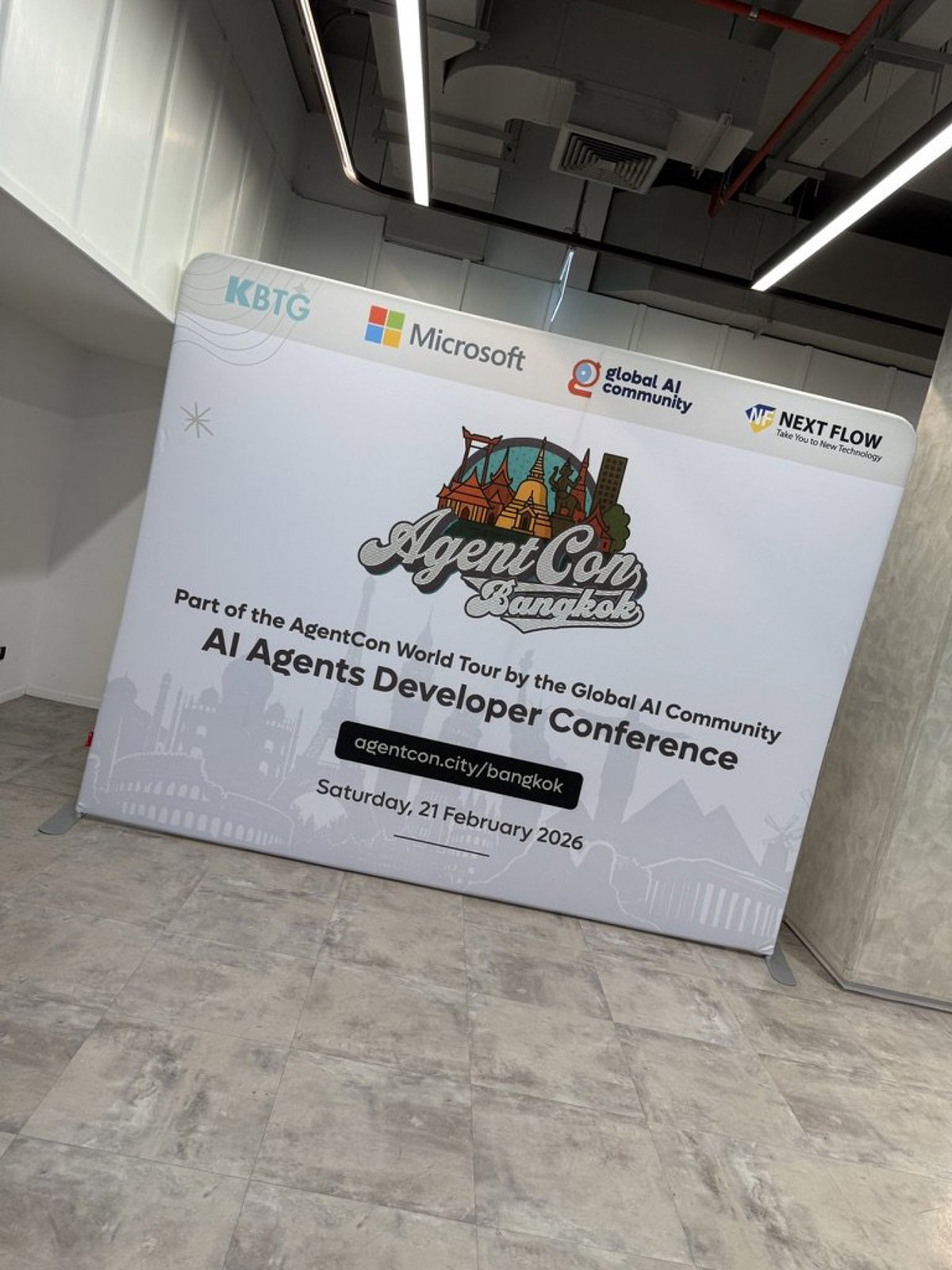
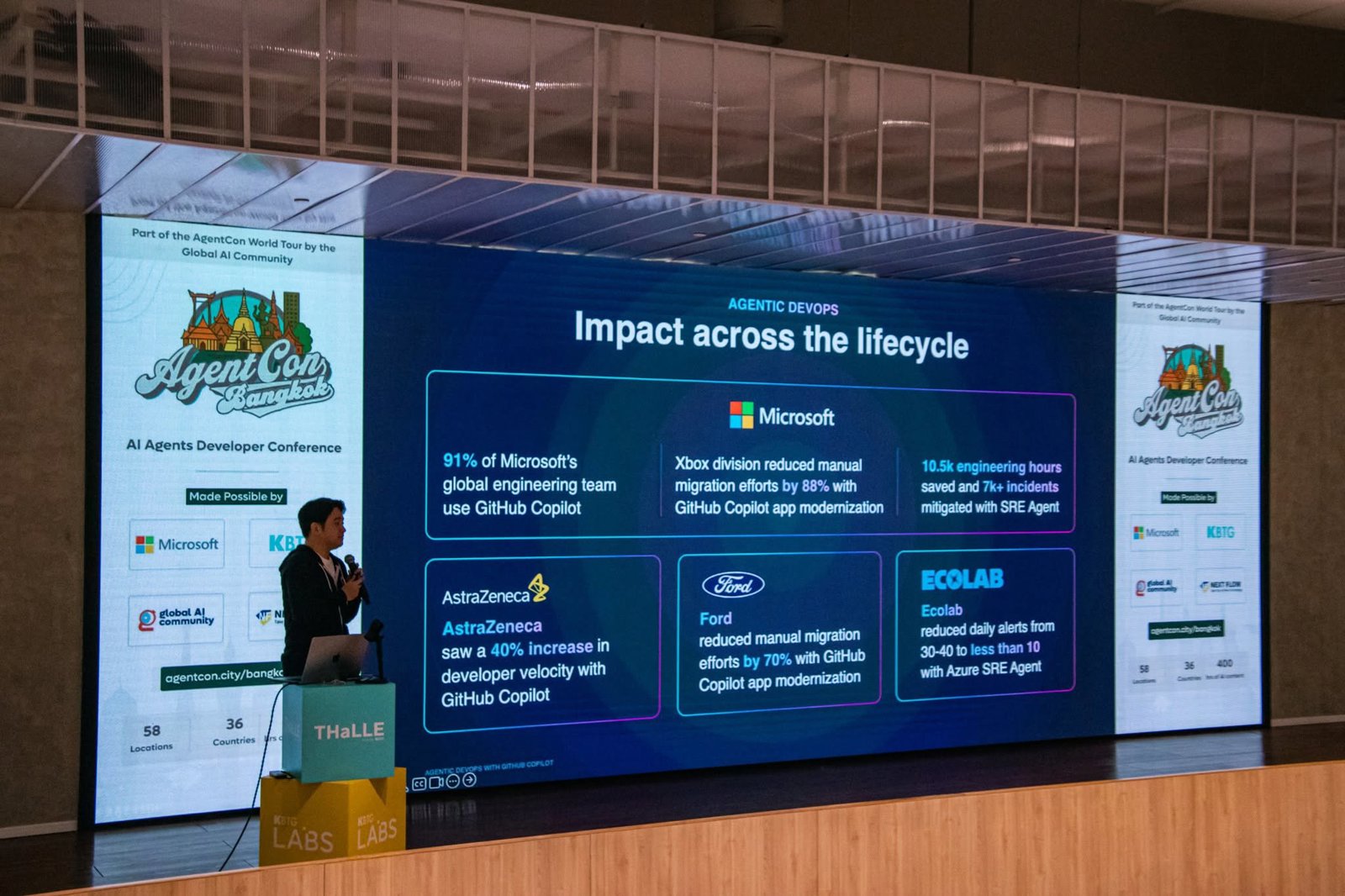
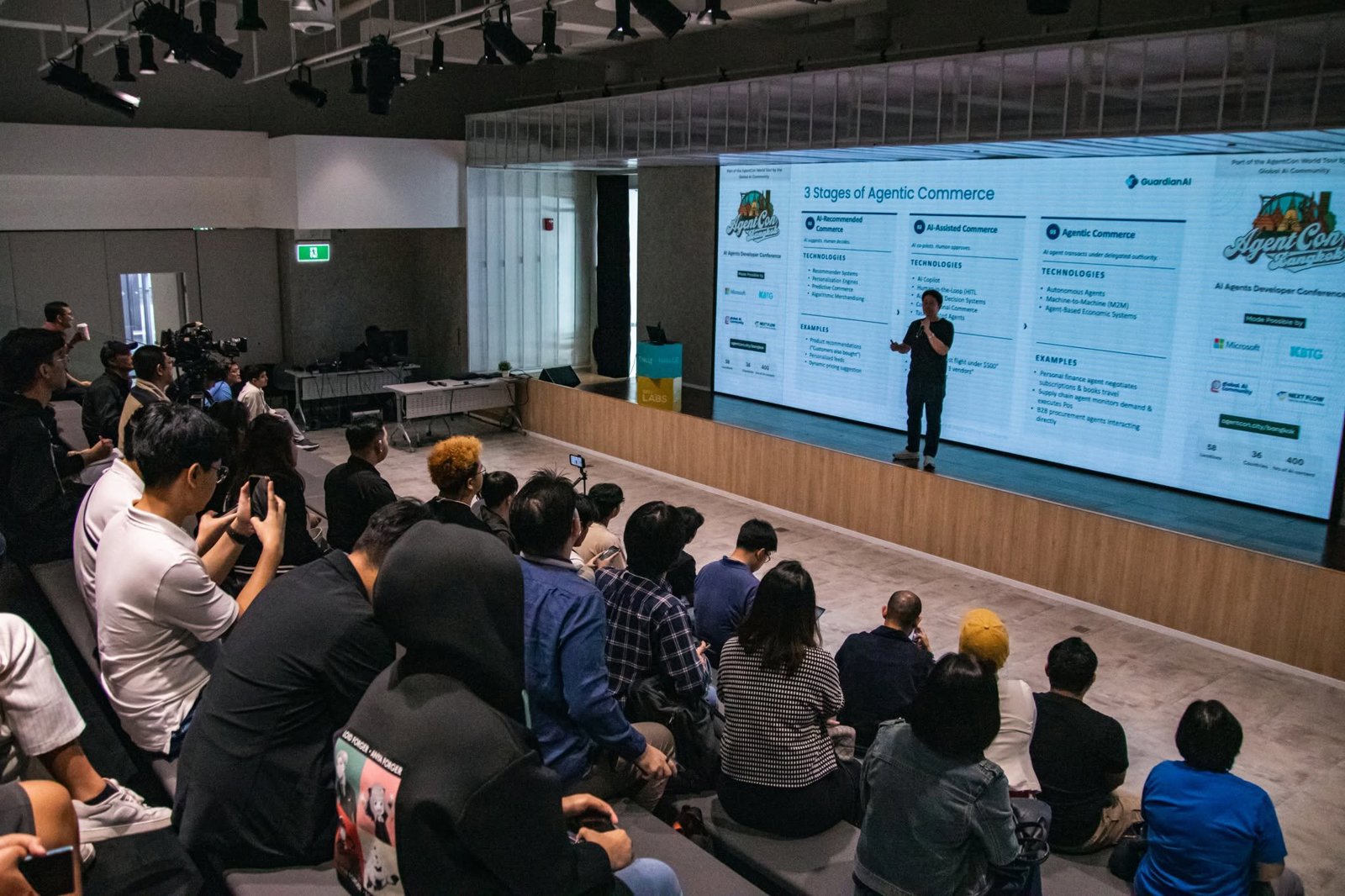
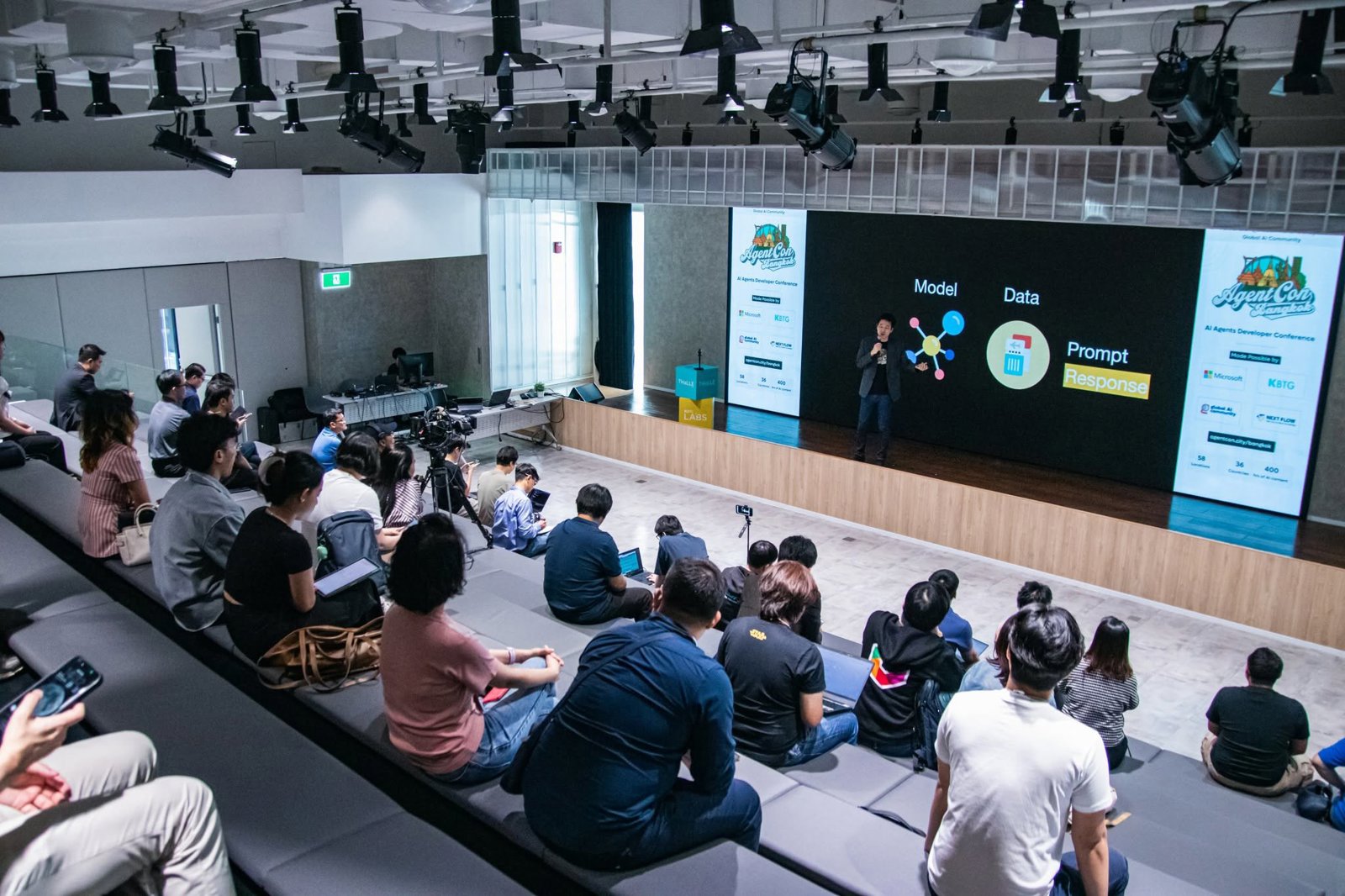
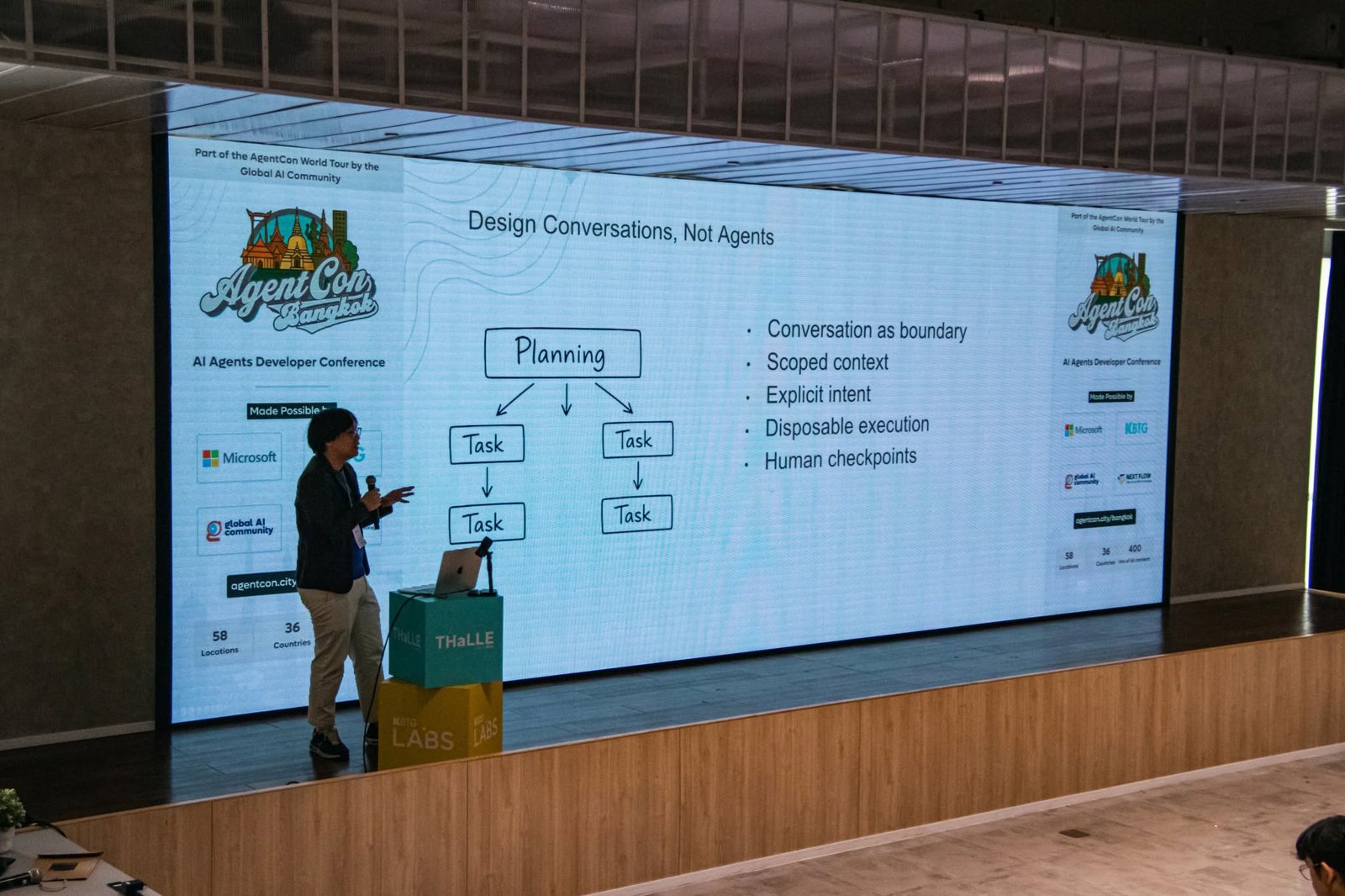
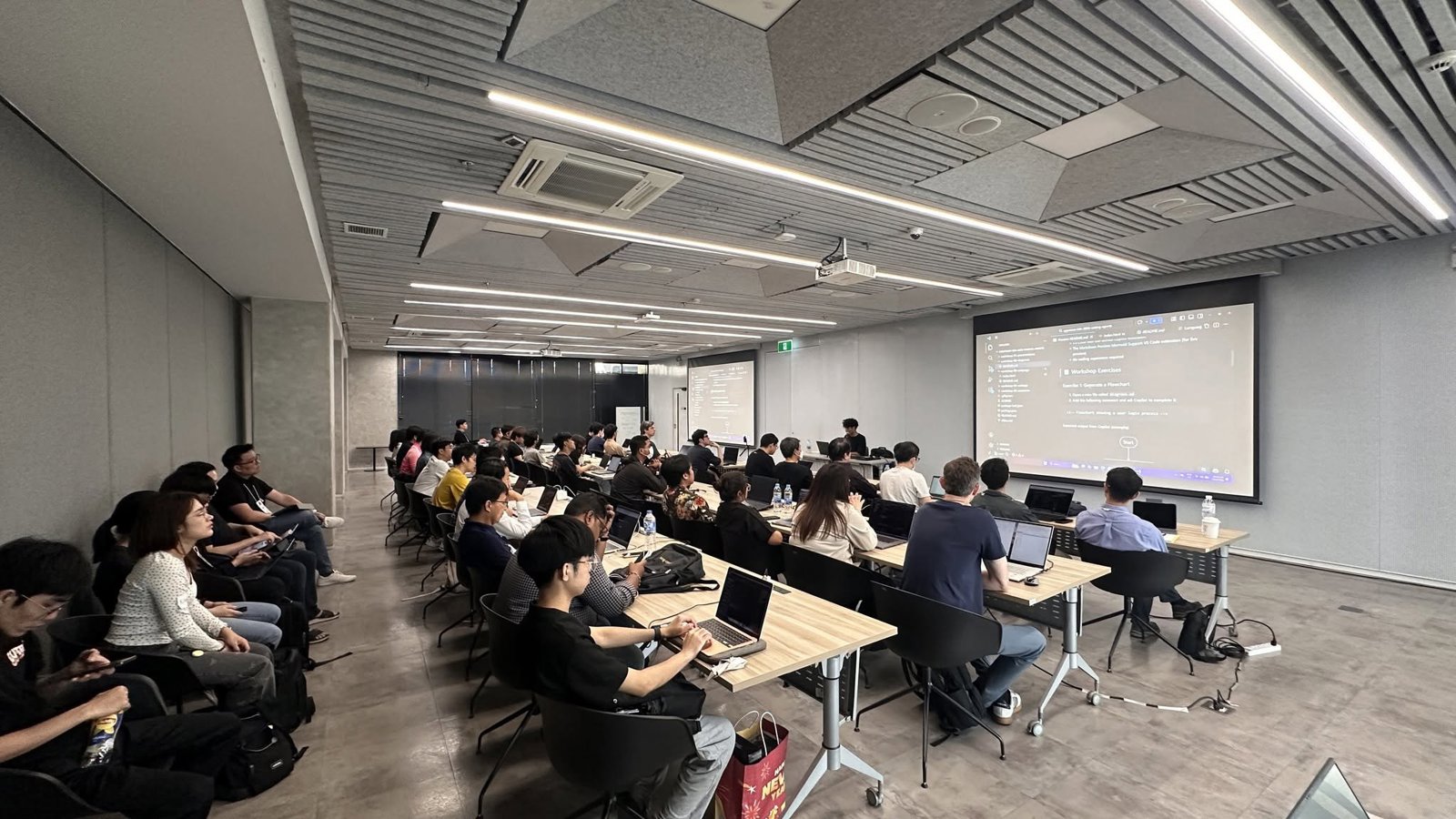
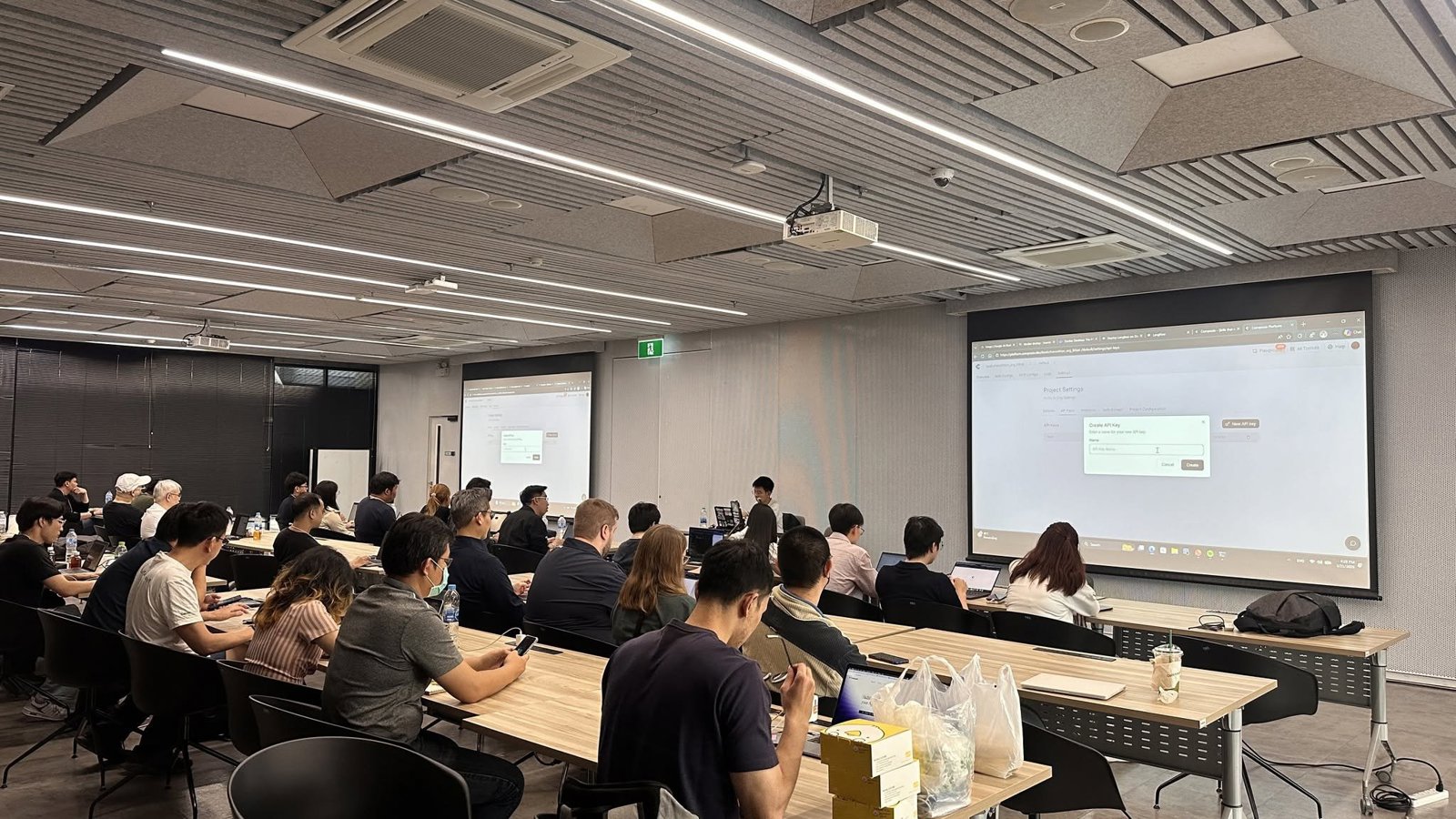
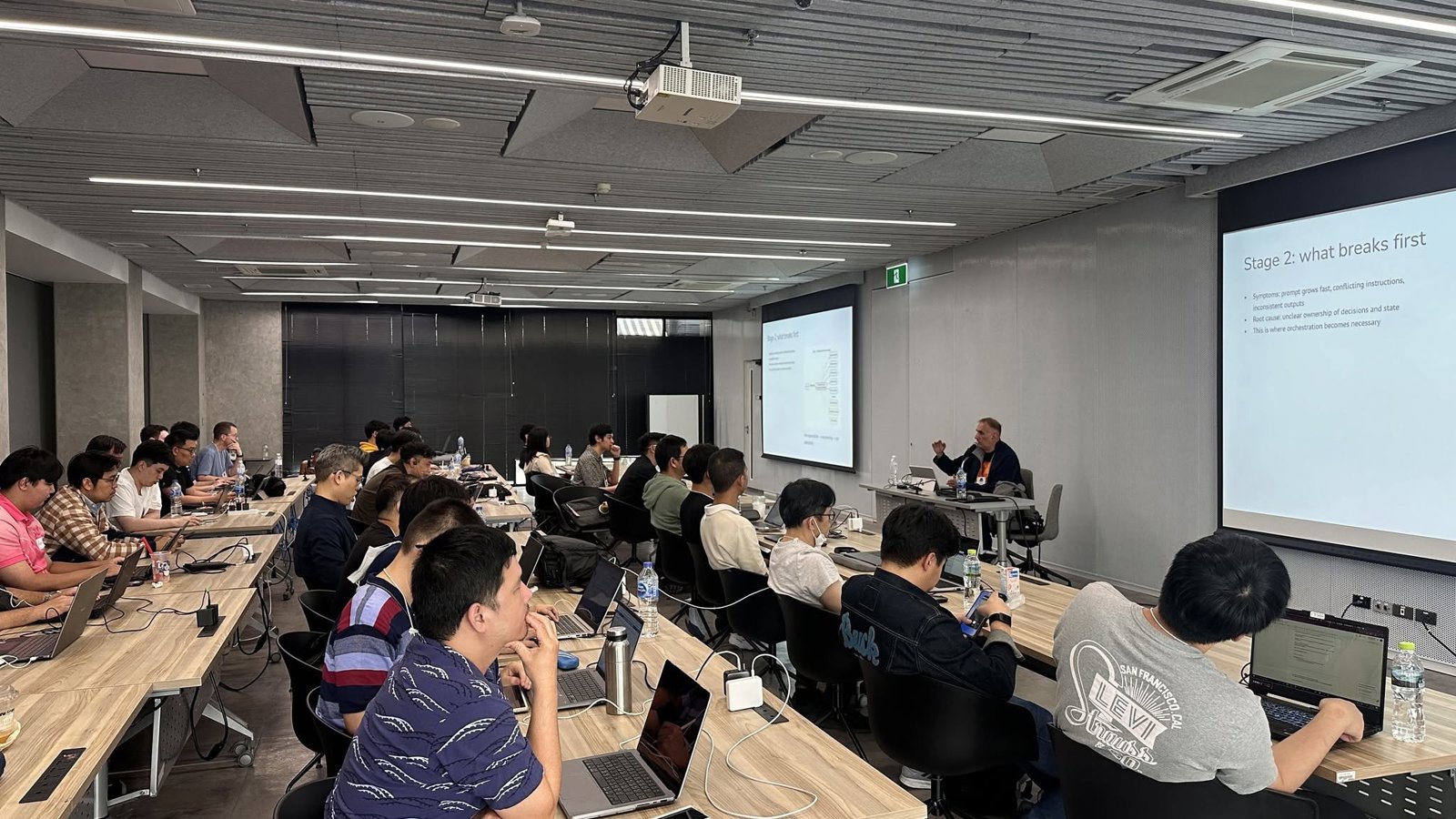
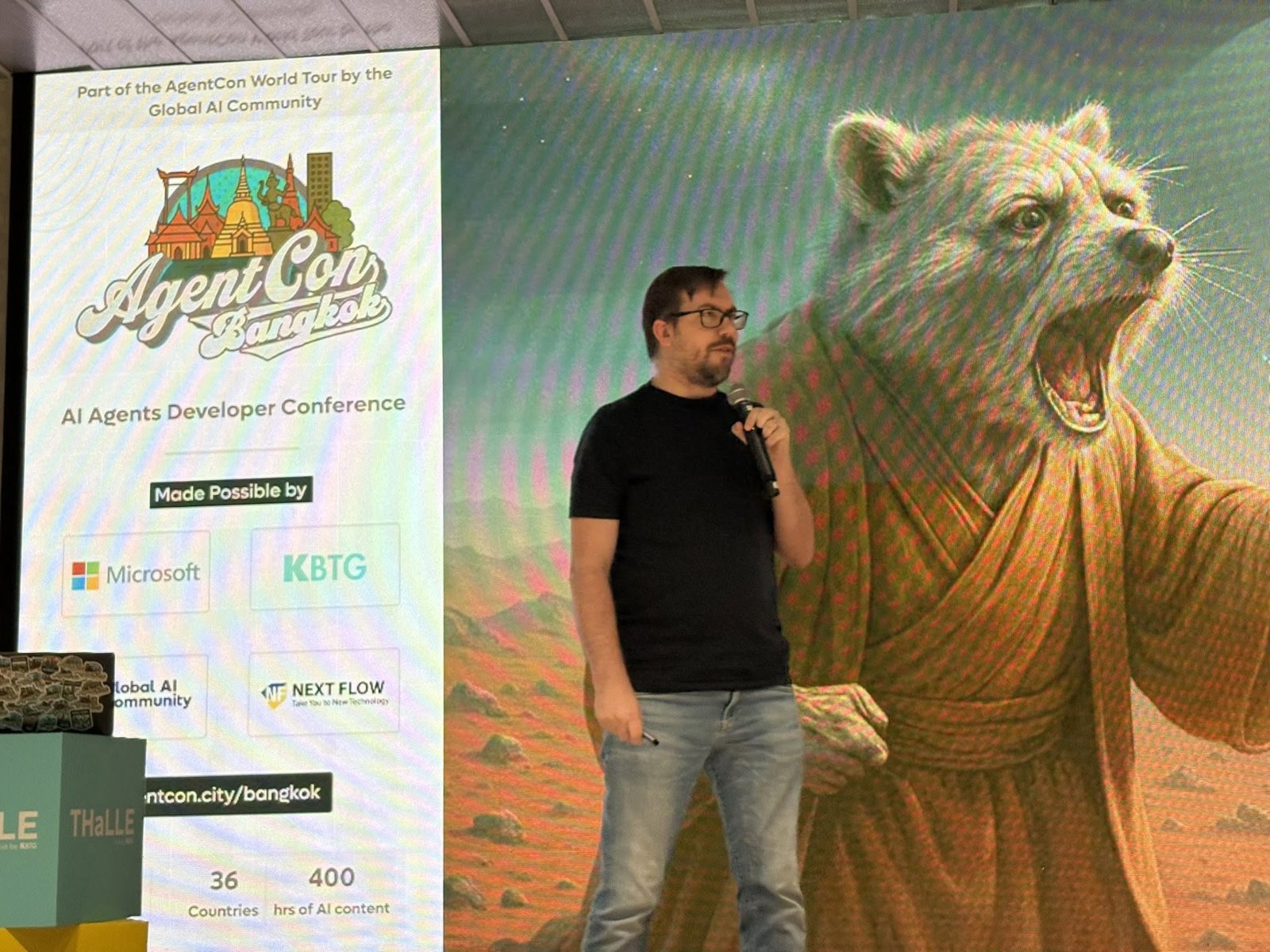
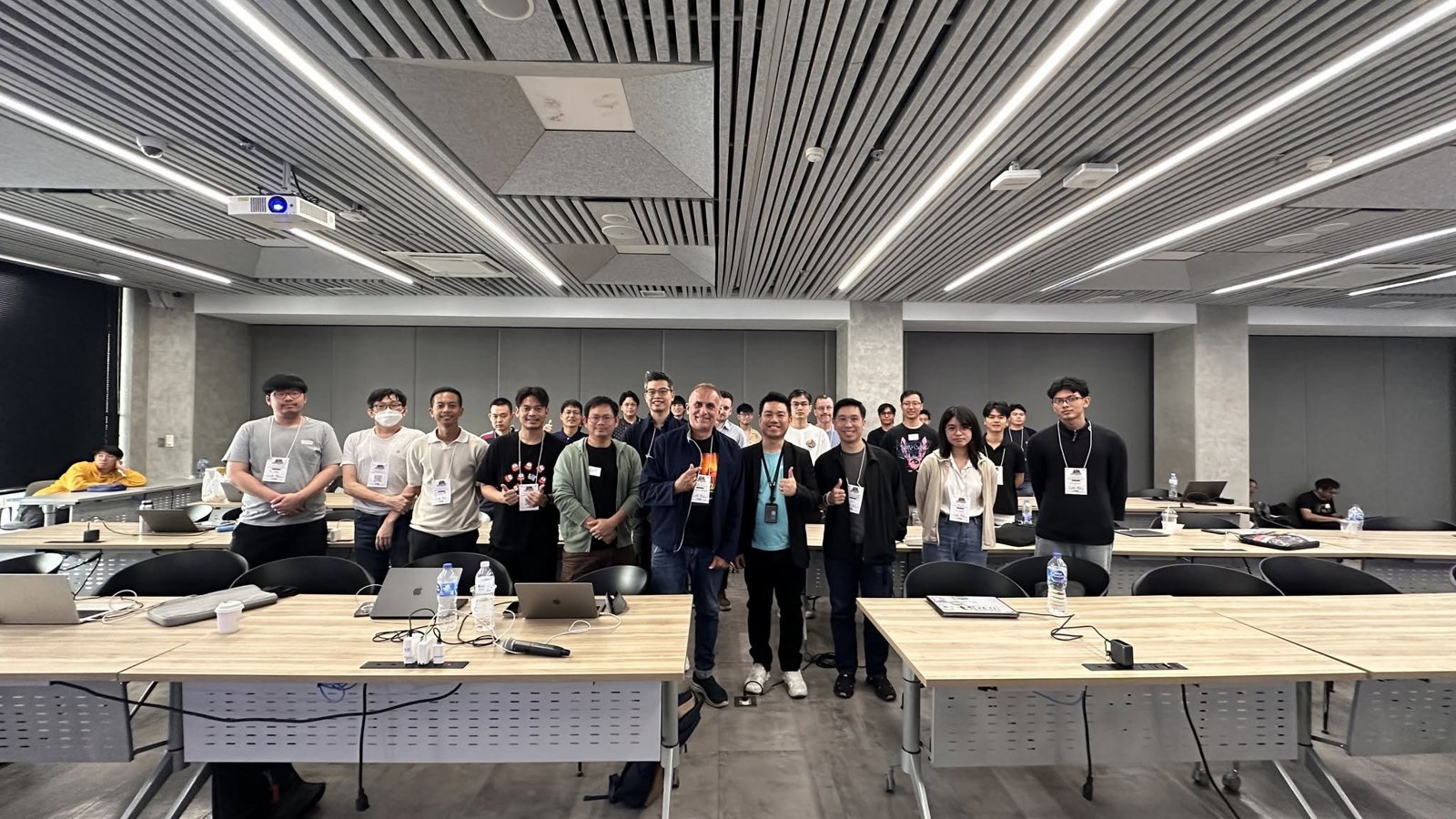
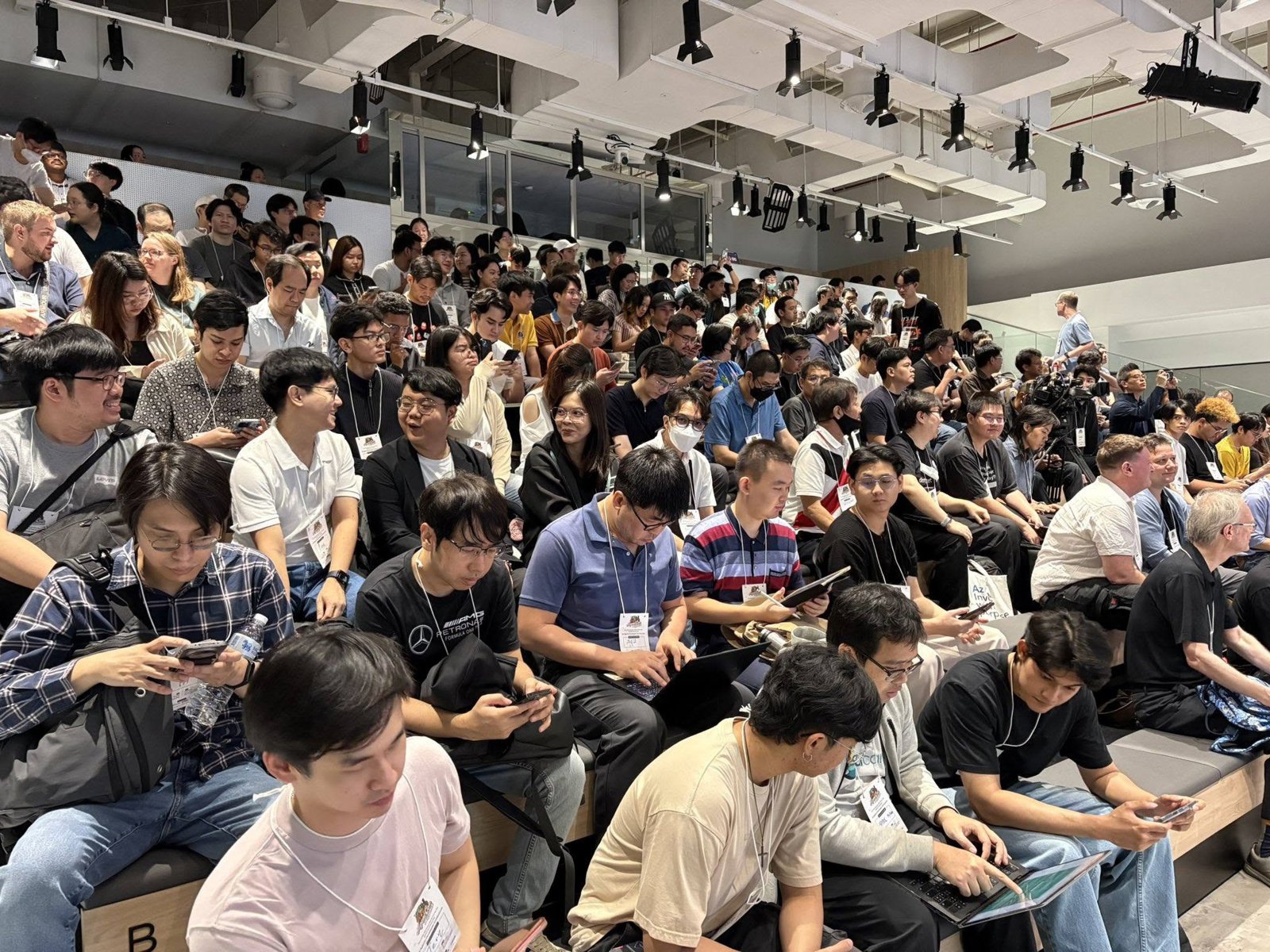
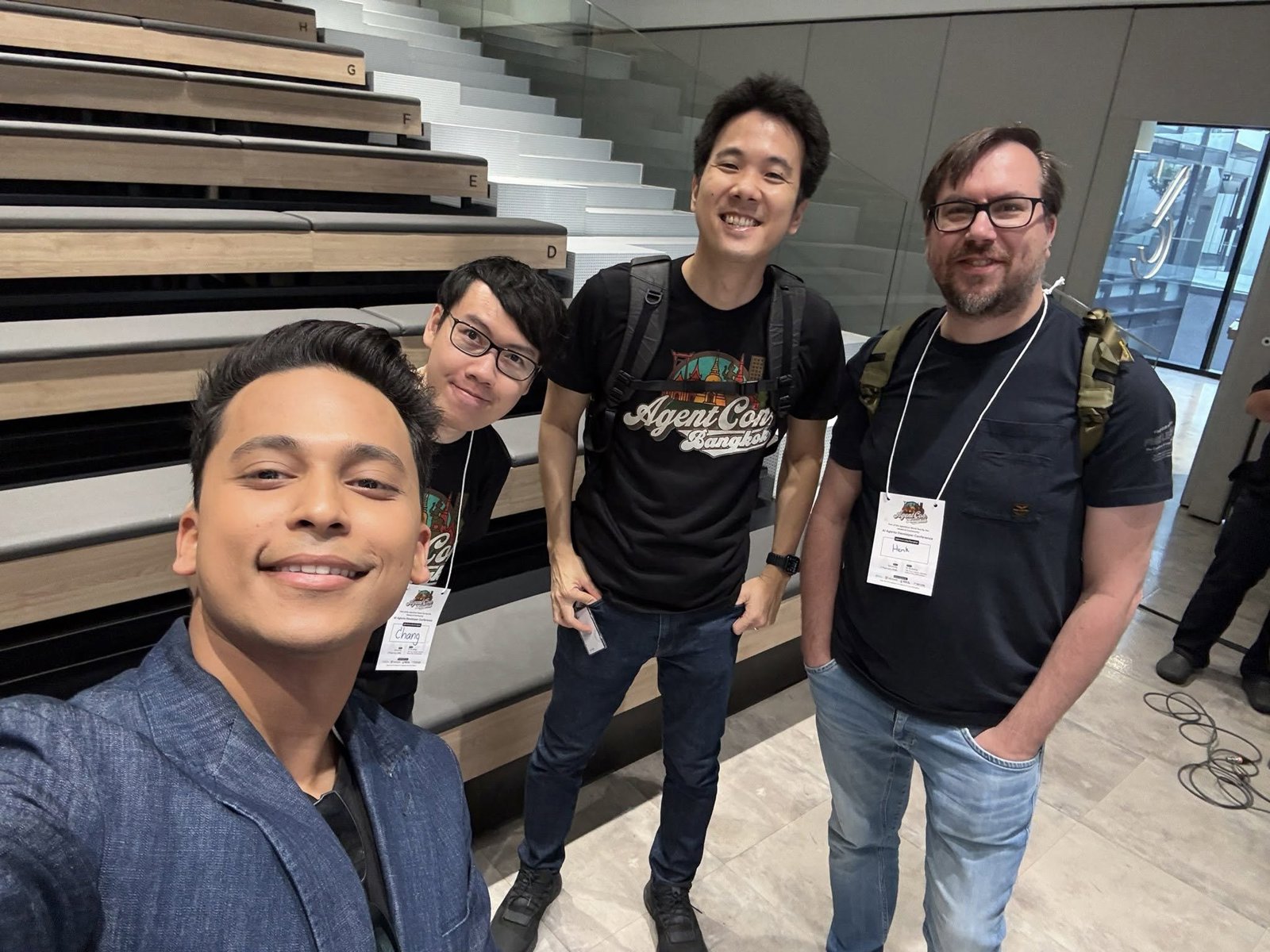
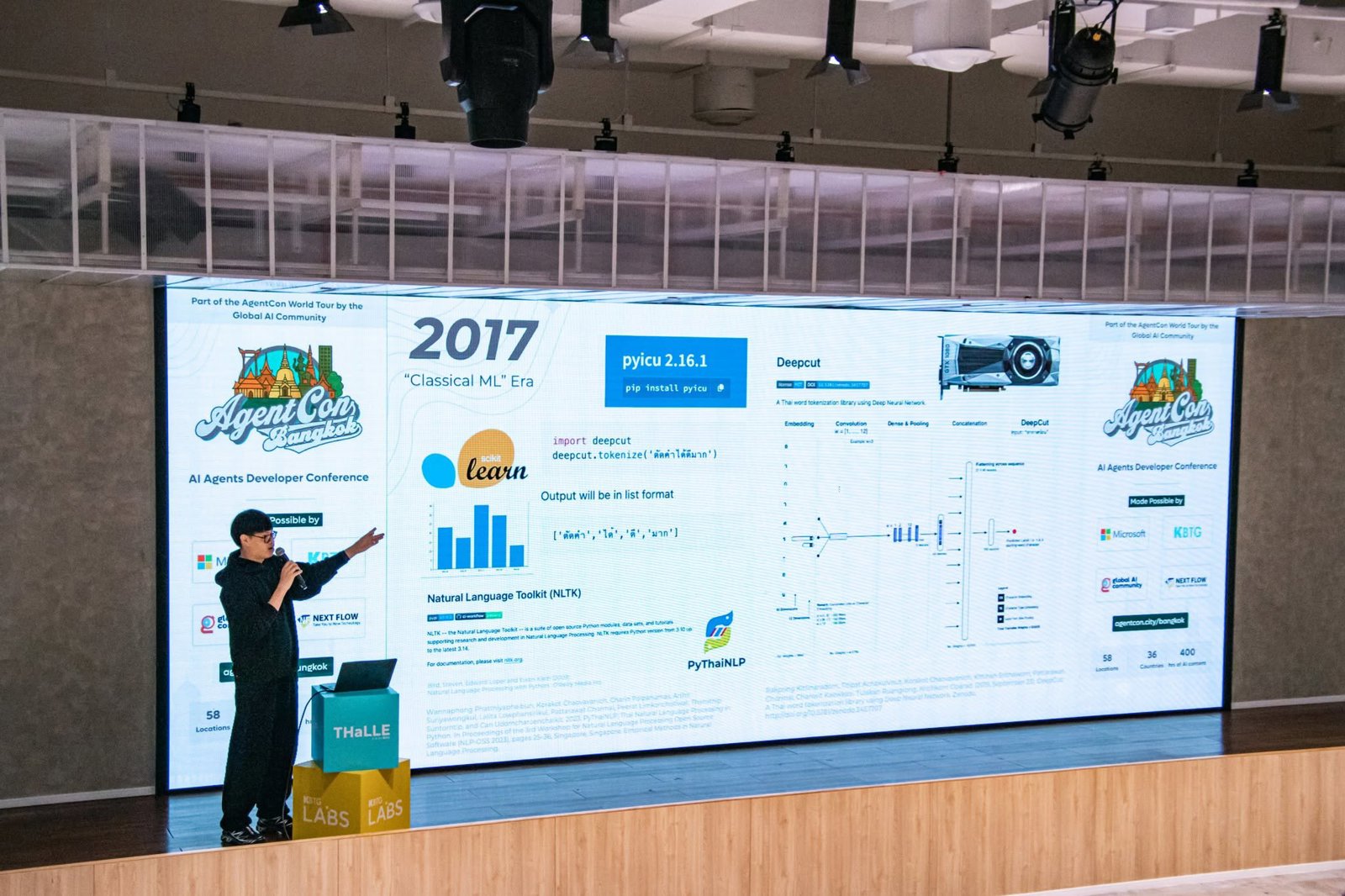
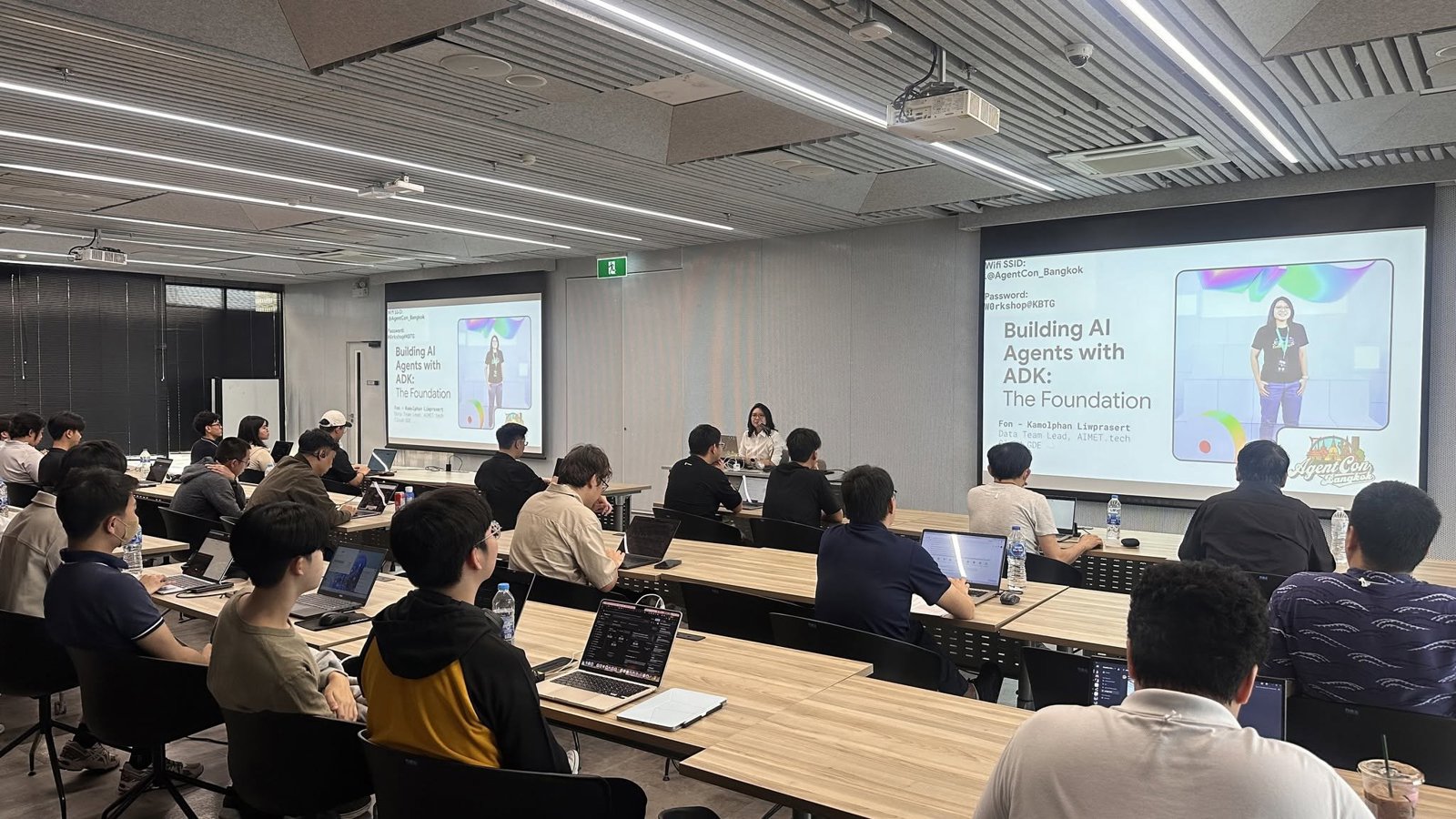
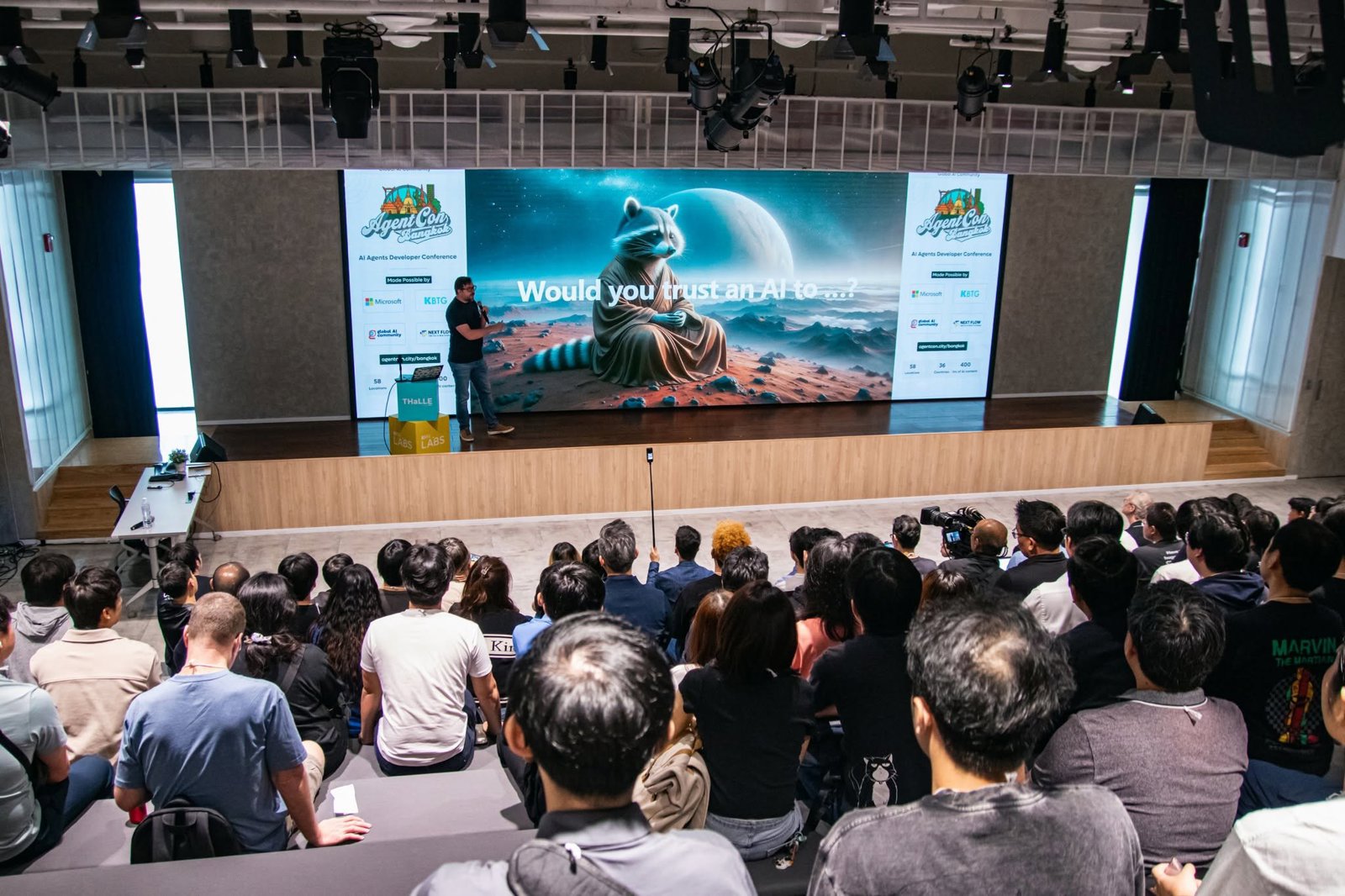
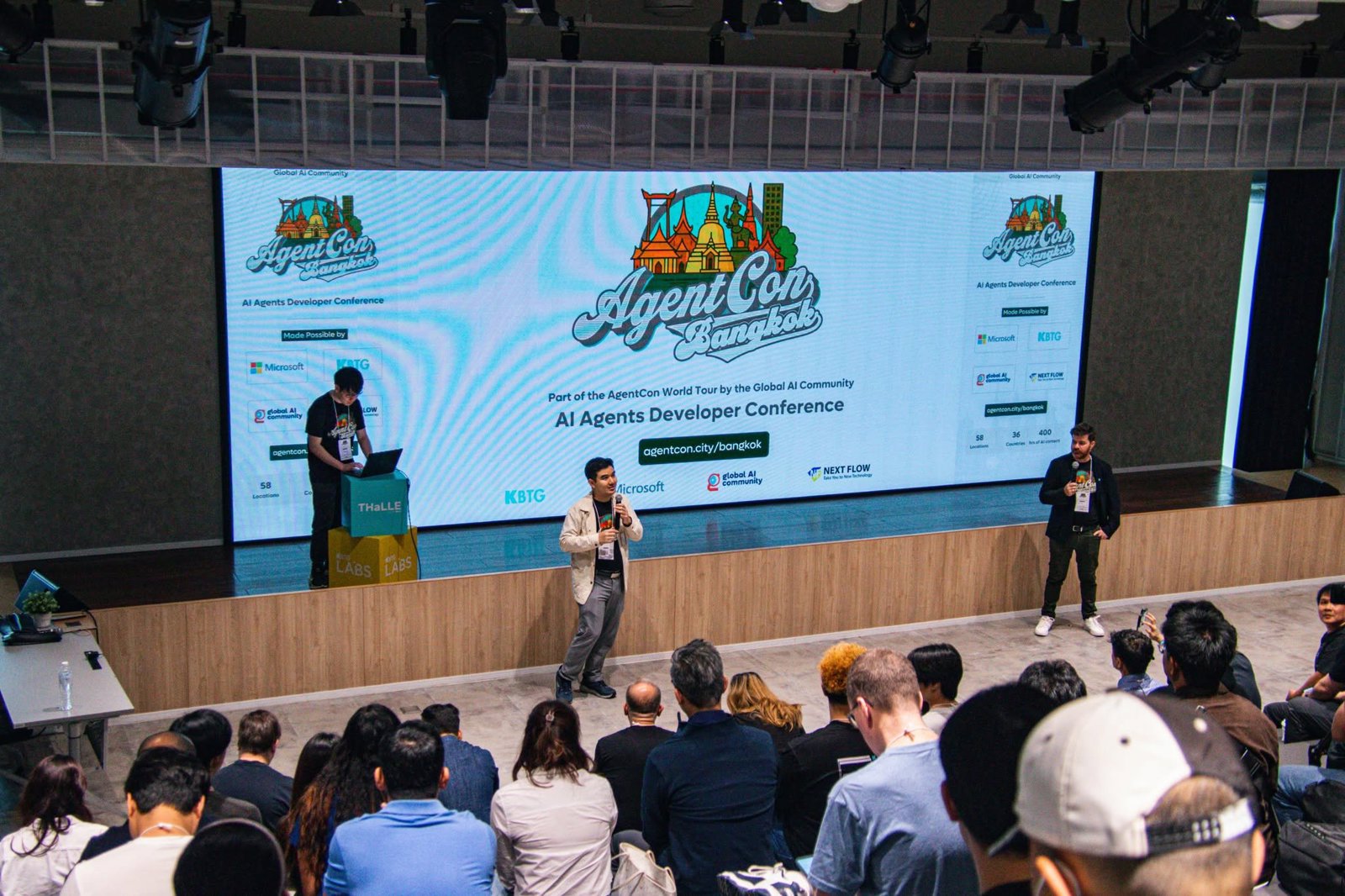
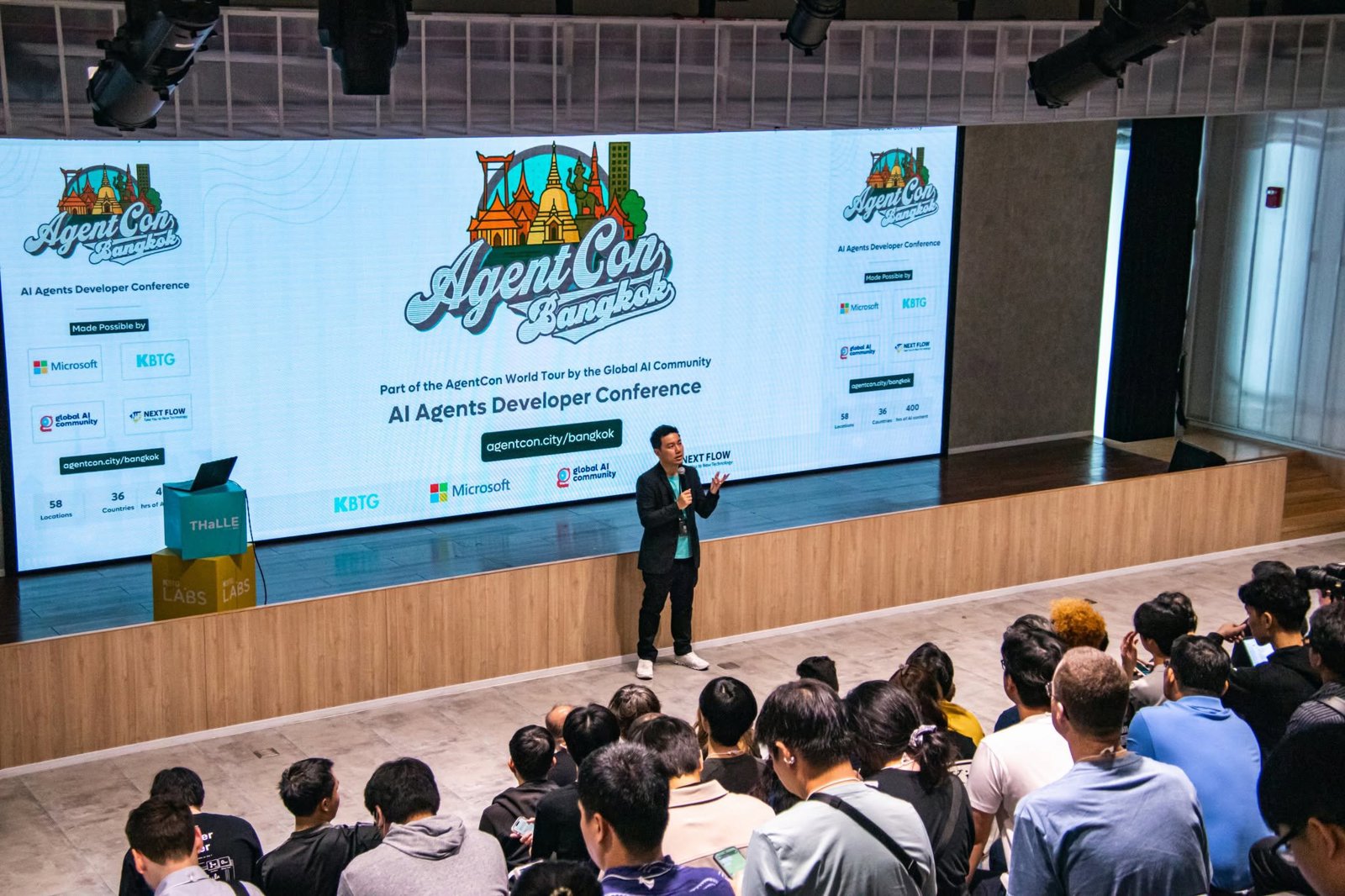
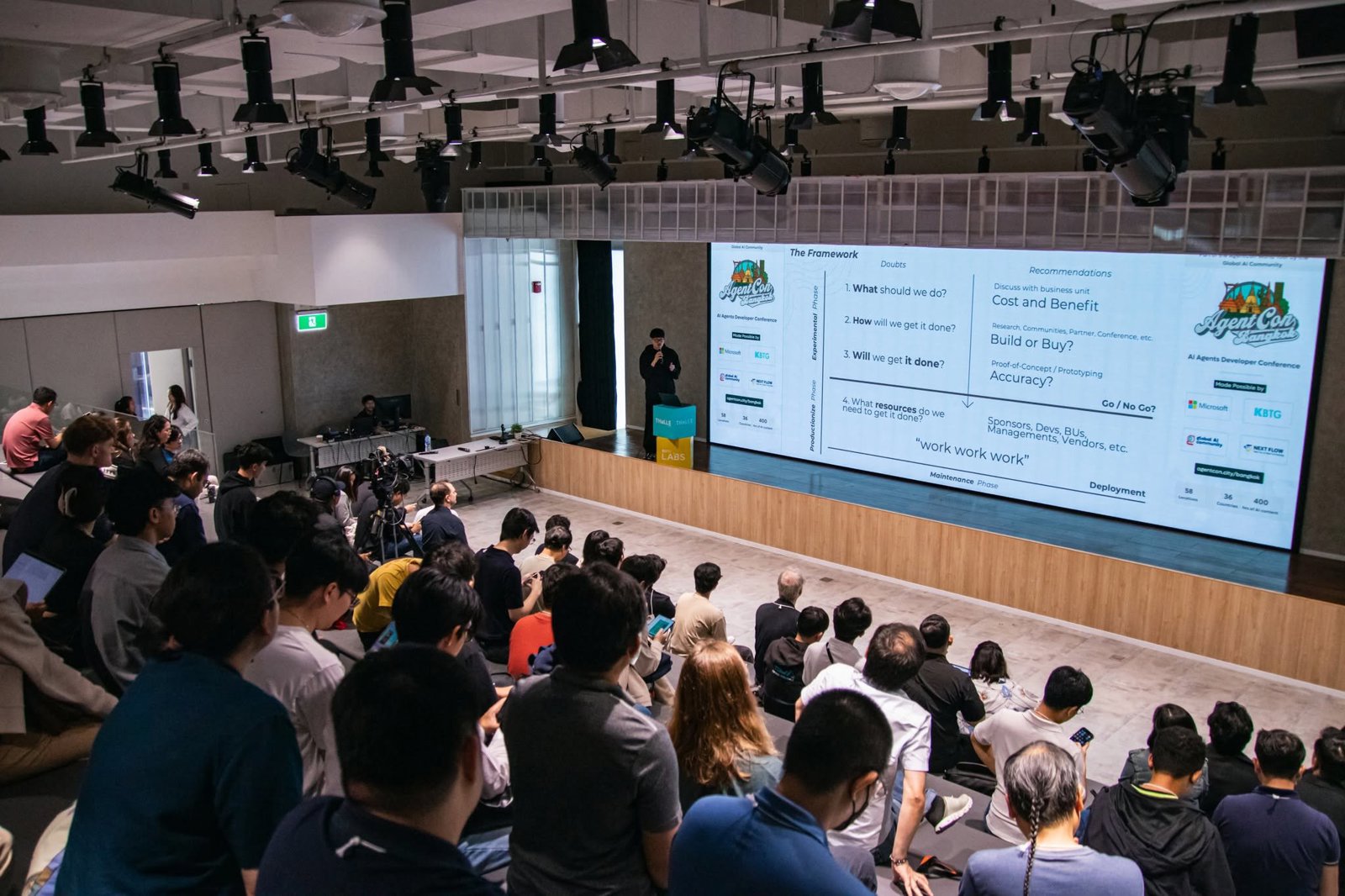
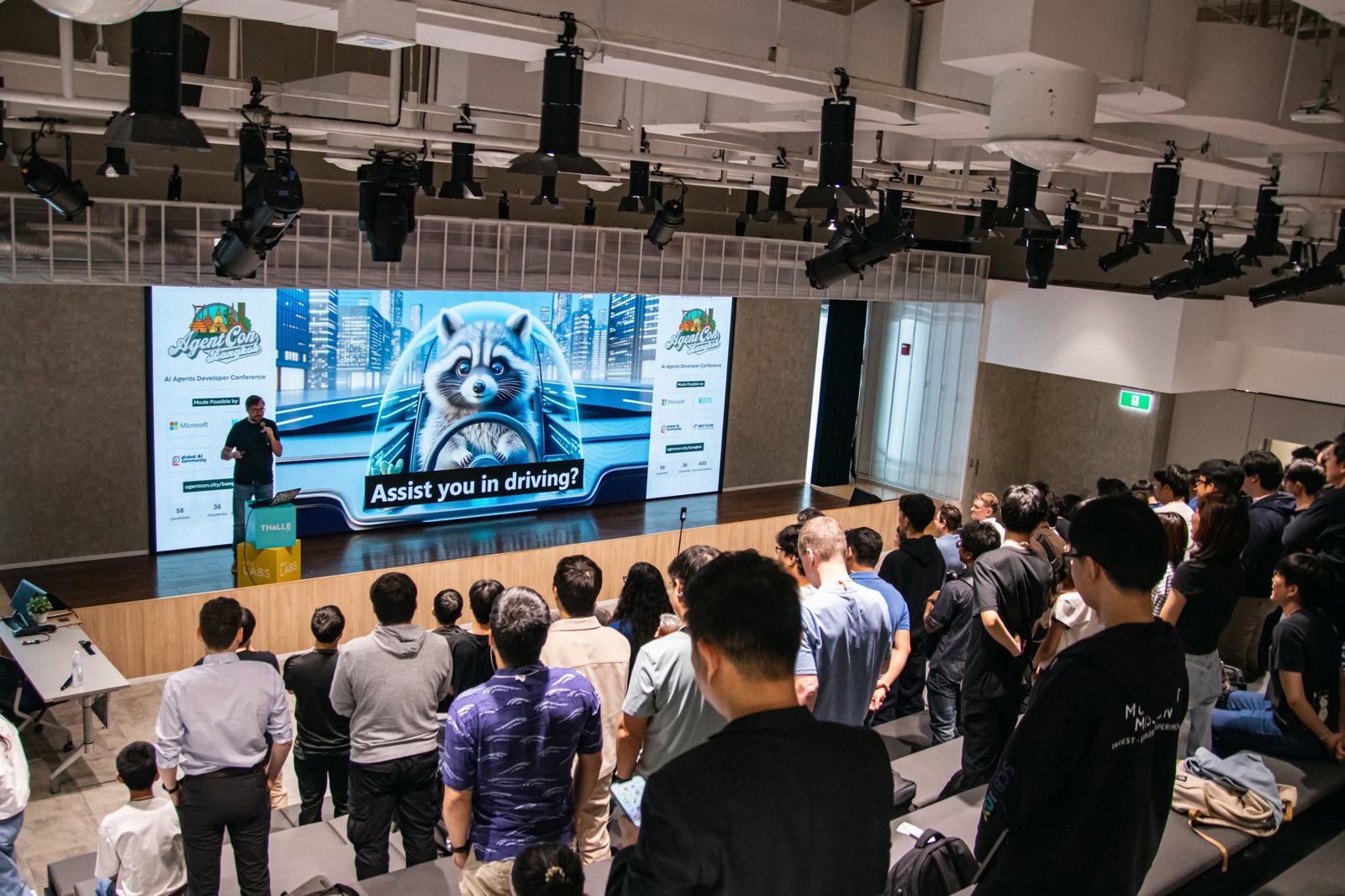
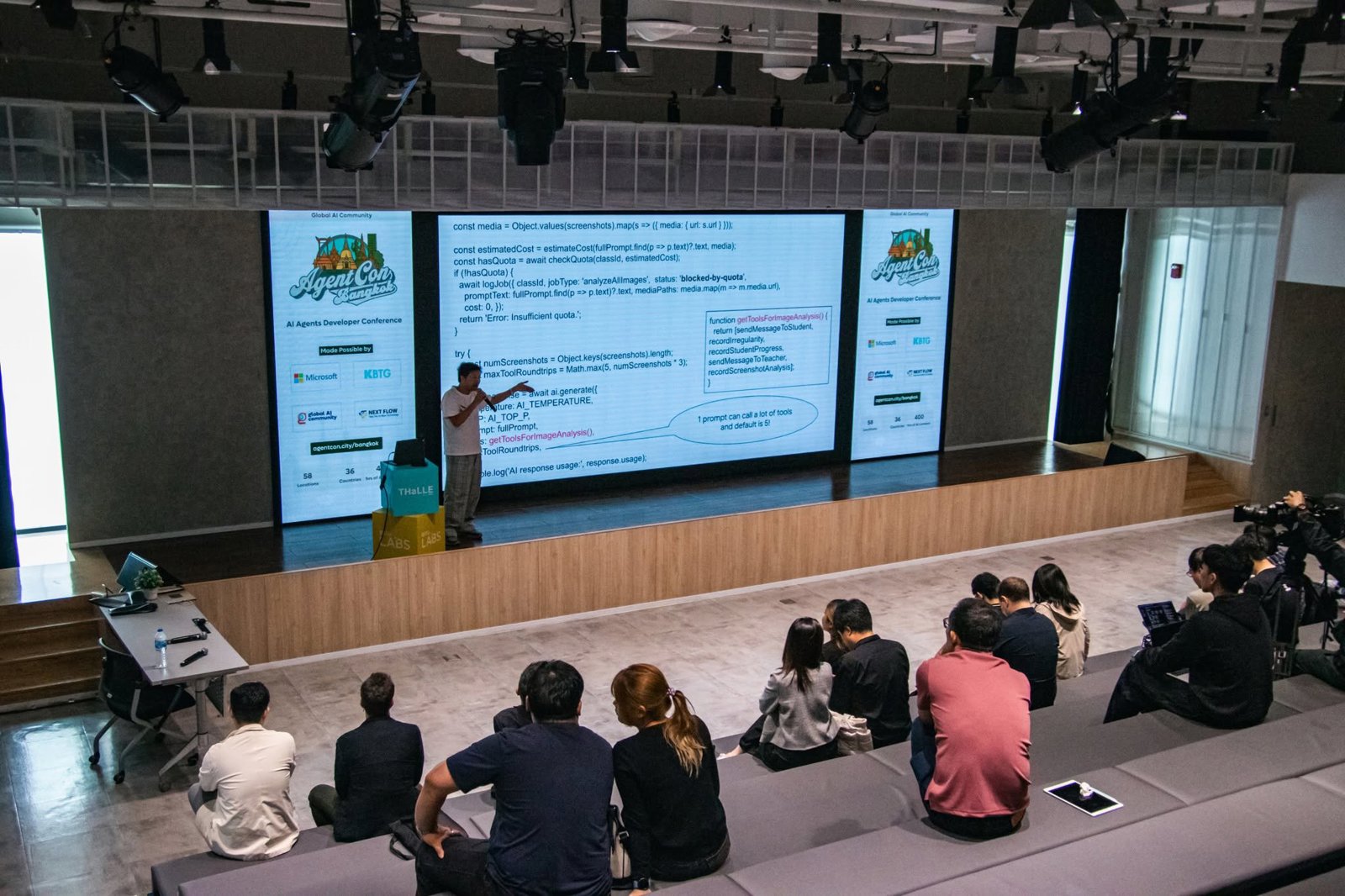
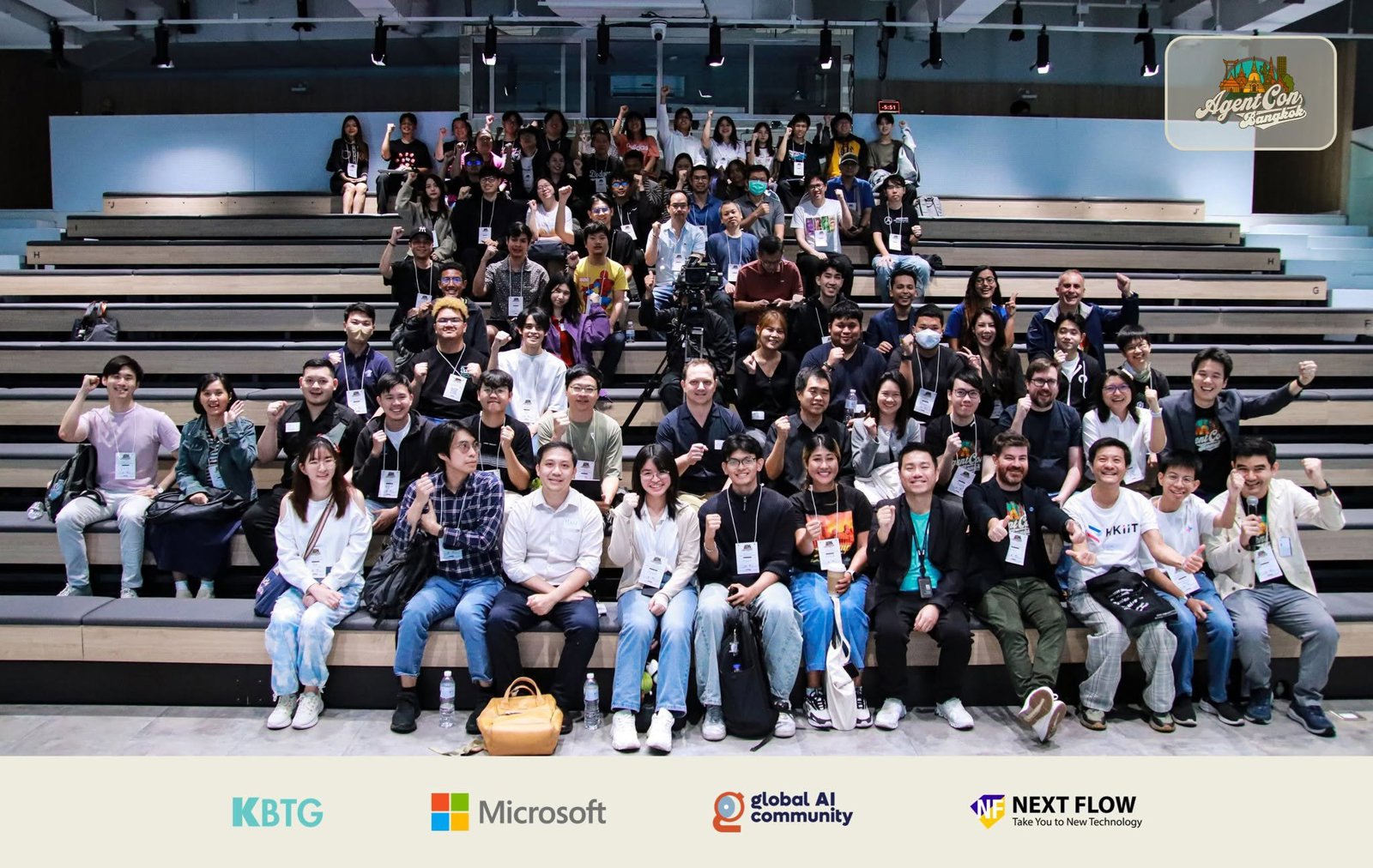
This is how it looked
Made possible by
Made possible by:



Explore AgentCon
AI Agents Developer Conference
AgentCon made possible by: